


What is the Geeta saar or the essence of the Bhagavad Gita?
In the Bhagavad Gita, Lord Krishna Bhagwan urged Arjun to fight in the war. This was because Arjun, seeing his own relatives and loved ones standing on the battlefield against him, was overcome with grief, thinking, “How sinful it would be for me to kill my own kin!” At that time, to remove Arjun’s delusion and prepare him to fulfil his duty in battle, Lord Shri Krishna imparted this knowledge to him.
Param Pujya Dada Bhagwan says that the essence of what Lord Shri Krishna wanted to convey in the Bhagavad Gita or the Geeta saar can be captured in just two words, “packing”, meaning the perishable body, and “material”, meaning the imperishable Soul. He explains that if these two words, packing and material are truly understood in their right sense, then the entire inner intent of Lord Shri Krishna as expressed in the Bhagavad Gita becomes clear.
Param Pujya Dadashri explains this essence here in simple language.
Dadashri: What did Lord Krishna mean? When a person dies, what is it that leaves when people say, “He left the body?” That, which leaves, is the ‘real thing’ and whatever is left behind is the ‘packing’. What you see with your physical eyes is the packing and the material (Soul or Atma) is within. There are varieties of packings. Some are in the form of a tree, some in the form of a donkey, some in the form of a man or a woman, etc., but the material, the content within each is the same. The packing can be in any form; it can even be rotten but a businessman is not really concerned with the outer packing, he is only concerned with the material within. Similarly, you should do the darshan of that material (the Self, the Lord) within the packing (body).
When Arjun trembled at the thought of killing his loved ones, Lord Krishna explained to him, “You are killing only those who are already dead.” The ‘packing’, meaning the body, is perishable and that is what you are striking down. The ‘material’, meaning the Soul within, is imperishable, and you yourself are of that very nature. What is perishable is merely being destroyed on both sides. Lord Krishna granted Arjun divine vision and revealed to him His Viraat Swaroop, giving him the knowledge of the entire time cycle, that countless Souls are born and die repeatedly, wandering through the four states of existence. Not only that, Lord Krishna told Arjun, “The ‘material’ that resides within all, that is I Myself, that is Krishna. Realize That.”
In the Bhagavad Gita, the imperishable nature of the Soul is explained in detail. The Soul cannot be pierced by weapons, nor can it be burned by fire. Water cannot wet it, nor can the wind dry it. Just as a person discards old clothes and puts on new ones, in the same way, at the time of death, the Soul leaves the old or diseased body and takes on a new one.
Param Pujya Dada Bhagwan says that, “The one who believes the Self to be the killer, or the one who believes the Self to be dead, neither of them understand. This is because it is not possible for anyone to kill this Self. Contrarily, those who believe that It [the Self] is dead, all of those people do not understand either. This is because this Self does not die nor can It get killed. This Self never takes birth nor does It die. It is not even that It was not around in the past or that It will not be around in the future; It certainly exists in the past, the present, and the future. ‘It’ is without birth (ajanma), permanent (nitya), eternal (shaashwat), It has existed since time immemorial. That is why even though the body dies, It cannot be killed. Oh Arjun! The One who Knows the Self to be indestructible (avinashi), permanent, without birth, and unchanging (avikaari), such a Self-realized One (Purush) can understand, ‘How can It kill anyone and in what way as well as how can It make anyone else kill another?’ He understands all that. The truth is, the Self gives up old garments and puts on new ones. There is nothing else to it.”
In Bhagavad Gita, Part 2, Shloka 16 Lord Shri Krishna also says that,
Naasato vidhyate bhaavo, naabhaavo vidhyate satah. |
Ubhayorapi drishtontasttvanayostattvadarshibhih || 16 ||
Param Pujya Dada Bhagwan explains its meaning as, “Asatno bhaav nathi,” means [that which is destructible] has no existence at all. Asat means that which is not an eternal element; there is no existence at all of that over here. And there is no non-existence (abhaav) of the Sat. Sat means eternal element (vastu). That which exists in the past, the present, and the future is called Sat. It remains in existence in all three time periods. That which never undergoes destruction is called Sat, and that which is destructible (vinashi) is called asat.” The Gita says, “Those who are tattvadarshi (with complete experience of the Self) conclusively See that ‘this’ is indestructible, and ‘this’ is destructible. That which has pervaded (vyaapt) throughout this entire body, Know that to be indestructible. This entire body has been pervaded by the Self. It is because the Self is present, that this body is in existence [alive]; otherwise, if this Self were to not be present, then the body would not exist, that is what it is trying to say. No one has the power to destroy that which does not wear away (avyay). No one has the power to destroy that which is indestructible, that is what the Gita says.”
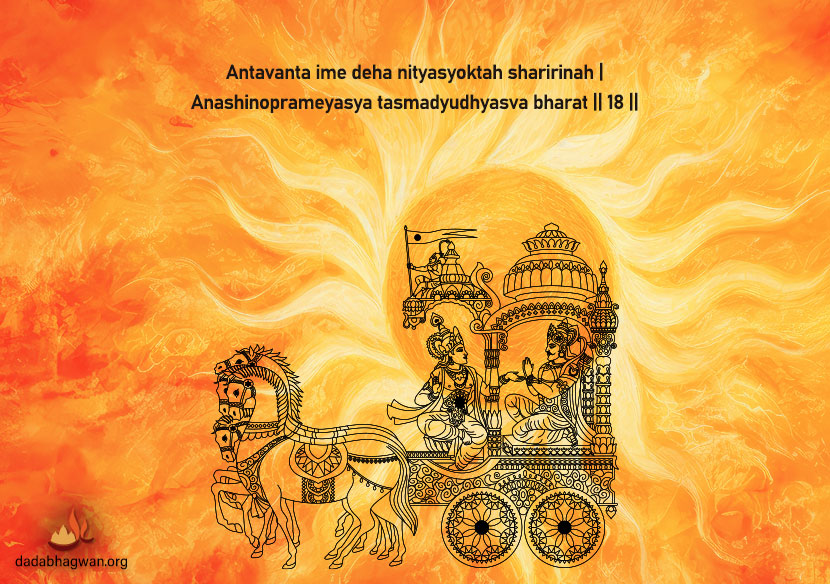
Thereafter in the Part 2, Shloka 18 Lord Shri Krishna says that,
Antavanta ime deha nityasyoktah sharirinah |
Anashinoprameyasya tasmadyudhyasva bharat || 18 ||
Param Pujya Dadashri while explaining its meaning, says that, “The Self is permanent (nitya), It is indestructible (avinashi), It is unconfined illumination (aprameya). The bodies of all these embodied souls [that stand before you in the battlefield] are destructible, so oh Arjun, fight this battle.”
He explains that when we say the body dies, that is only in worldly language. In the language of God, no one truly dies and no one is born. It is only the puppet-like bodies that are born and that die. One who truly “dies” would be someone who ceases to exist forever, but the soul never ceases to exist. Creation and destruction, creation and destruction, keep occurring again and again, yet the Self remains constant and unchanging. The phases get created and destroyed, they have a beginning and they come to an end. For example, after birth comes youth; then youth fades away and old age comes. Later, even old age passes away. In this way, all phases begin and come to an end, but the Self or Soul itself is permanent.
This Geeta saar should not be misused to mean that “since the Soul never dies, there is no harm in killing living beings.” Taking the life of any creature, especially a human, binds one with heavy demerit karma. This message was given by Lord Shri Krishna only to Arjun, who was wavering from his Kshatriya duty, and along with the message He gave him the Knowledge of how one could even fight a war without creating new karma.
The significance of the living
Param Pujya Dadashri says that, “Arjun was overcome with worldly attachment. In spite of having the duty (dharma) of a Kshatriya (those meant to perform the role of a warrior), he was overcome with attachment (moha) for his brothers and teachers who were posing as his enemies. To remove this delusion, Lord Krishna cautioned Arjun and said, Remove your illusion. Come to Your dharma. Be the Self. Do not become the doer or the non-doer of karma.” But this teaching was not meant for all times. It was appropriate only for that moment, to remove Arjun’s delusion. Because this point was not understood correctly, people began to question why did Lord Shri Krishna, despite being enlightened, tell Arjun to kill everyone? Lord Shri Krishna knew that Arjun’s delusion would soon fade away and that, by his very Kshatriya nature, he would not be able to abstain from battle. Therefore, in an evidentiary form, Lord Shri Krishna told Arjun, “Perform your duty and engage in the act of war. But do not fall into the false attachment or ego of thinking, ‘I am the one who is fighting’.”
Moreover, Lord Shri Krishna was personally present before Arjun. Through the living enlightened One, Arjun attained the vision of the eternal Self. After gaining that vision, Arjun finally said to Lord Shri Krishna, “My delusion has been destroyed; now, I will act according to Your command.” Upon realizing the true Knowledge of the destructible and the indestructible, Arjun completed the task of battle while remaining in the akarma (not charging karma) state, not binding even a single karma. Not only that, by remaining steadfast in this Knowledge, Arjun, in the very same body, attained Moksha (ultimate liberation from all karma)! By gaining the right belief of ‘I am pure Soul’, from a living Gnani (the enlightened One who can enlighten others) and living in accordance with His guidance, the path to ultimate liberation became open!
Lord Shri Krishna was personally present for Arjun. He told him, “Abandon all forms of religion and surrender solely unto Me.” Explaining the meaning of this, Param Pujya Dadashri says that Lord Shri Krishna spoke these words as the embodiment of the Soul, where the “I” refers to Krishna, and Krishna means the Soul itself. Within every being resides the Soul, and that very Soul is Krishna; within it lies Moksha. Param Pujya Dadashri says that when Lord Shri Krishna said, “I am the one who does this...,” He was speaking as the Soul itself. But people misunderstood and assumed that He was speaking as a person, taking it to mean, “I am the doer, and I have created this world.” In reality, that is not the case, Lord Krishna was speaking as the embodiment of the Soul.
The message from Lord Shri Krishna’s heart
In the Bhagavad Gita, Param Pujya Dada Bhagwan explains through a practical example of how, over time, the Geeta saar, the true essence of Lord Shri Krishna’s heartfelt message has gradually changed in human understanding.
Dadashri: When a young man is in college, his father writes him a strong letter, “You do not study and waste my money. All you do is watch movies and plays.” The son shows the letter to his friend and says, “See what my father is like? He is an animal. He is an angry man. He is an angry, greedy and a tight fisted man.” The young man says that because he does not understand what his father is saying. He cannot understand his father’s inner intent. The age difference between him and his father is only 25 years and yet he does not understand his father’s intention, so who can understand Lord Krishna’s intention after five thousand years? Who can expose Lord Krishna’s intention? Only the one who is Lord Krishna himself can do so. Who can expose Lord Mahavir’s intent? Only Lord Mahavir himself! And the time difference between Lord Mahavir and now is 2500 years!
Param Pujya Dada Bhagwan here helps us understand the heartfelt message of Lord Shri Krishna in the Bhagavad Gita, that which is deeply complex to truly grasp.
Dadashri: “Only one out of a thousand people will understand the gross or overt (sthool) meaning of what I am saying in the Gita. Out of thousand such people, only one can understand the subtle (sookshma) meaning of what I am saying. Out of one thousand such people, only one can understand the subtler (sookshmatar) meaning, out of those who understand the subtler meaning, only one can understand exactly the essence (sookshmatam) of what I am saying.” (One in a trillion) Now out of three and a half billion people, who would qualify to understand what Lord Krishna was saying?
Only from a Gnani Purush (the enlightened One) can one obtain the real essence of all the scriptures.

subscribe your email for our latest news and events
Dada Bhagwan Foundation, Adalaj is a spiritual non-profit organization whose goal is to spread peace, harmony and everlasting bliss to the whole world through the spiritual science of Akram Vignan.
Ask a question and Get an assured response


