


What four types of devotees are mentioned in the Gita?
In the Bhagavad Gita, in order to remain connected with God and to attain the highest state, various paths such as Gnanyog, karmayog, and bhaktiyog (cultivation of a devotional relationship with God through prayer) are shown.
Focusing on the path of devotion, Shri Krishna describes the different types of devotees in the seventh chapter of the Gita.
Chaturvidhaa bhajante maam janaaḥ sukritino’rjuna |
Aarto jignaasuraarthaarthi Gnani cha bharatarshabh || 16 ||
This means that four kinds of devotees become absorbed in My devotion. One is the aartabhakta, the devotee who is suffering. The second type is the arthaarthi, the devotee who desires worldly benefits. The third type is the jignaasu, the seeker who wants to know. And the fourth type of devotee is the Gnanbhakt.
In reality, whatever is done through the five senses for attaining God is called devotion. Through devotion, one develops a connection with God, and through that, the steps of progress on the path of dharma are laid.
The first type among these is the aartabhakta. These types of devotees have become distressed by the experiences of worldly life; they do not find any other way to become happy, so ultimately they turn to God and ask Him to remove their suffering. However, such devotees remember God only when they are in pain, and when happiness comes, they forget Him. For example, if their leg is paining, an aartabhakta prays to God, “O Lord! Have mercy on me, remove my pain, please show Your grace!” If a devotee’s young son is very ill and does not recover despite many efforts, he prays to God, “O Lord! If my son becomes well, I will observe fifteen full-moon fasts.” Thus, even God understands that they remember Him only because they are struck by suffering. Such aartabhaktas, who remember God only when sorrow hits, can be found everywhere.
The second type is the arthaarthi bhakts, who worship God for artha, that is, to obtain some worldly gain. For example, a couple who cannot have a child prays with the hope of having a son, “O God, if a baby boy is born to us, I will offer this many coconuts.” Or, someone wishing for their business to run well, takes a vow, “O Goddess, if my business prospers, I will offer you a chunari.” These types of devotees are called arthaarthi bhakts. Having faith in any God or deity and taking vows according to one’s belief is a matter of personal devotion. But remembering God only for selfish reasons, and then forgetting God once that purpose is fulfilled, these are the characteristics of an arthaarthi bhakta.
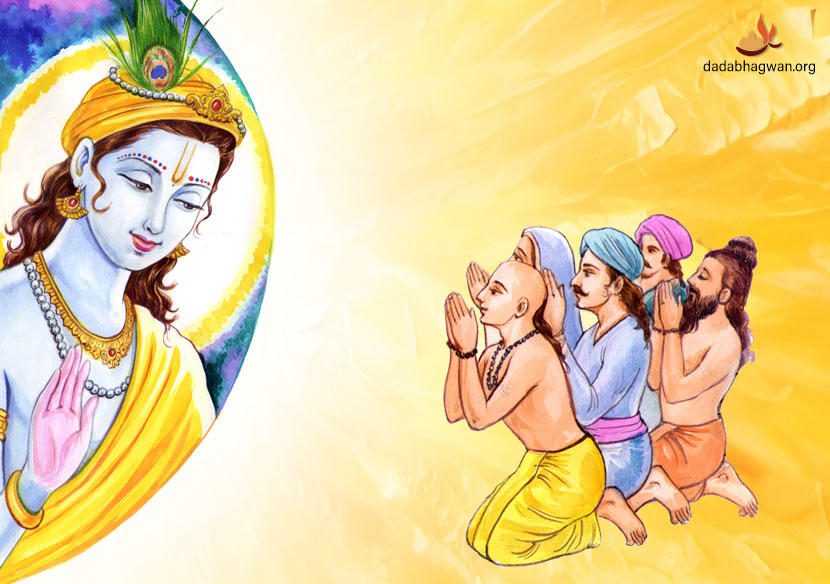
The third type is the jignaasu bhakta. Such devotees eagerly long for the vision of God. They have a desire to know something true and meaningful. They do not worship out of worldly sorrow or delusion, but out of a genuine longing to attain God. Questions constantly arise within them such as “What must God be like? How must He look? Where does He reside? What does He do? What does He not do?” Those who surrender themselves to God, with the curiosity to know Him completely, remain in search of God. Going further, when all attachment to worldly things has totally faded away and only the desire to know the Self remains, that is called intense mumukshutaa.
The fourth type of devotee is the Gnani bhakta. Such types of devotees have attained the direct realization of the God who resides within themselves, and thereafter they remain constantly established in the form of the Self. At that stage, there is no difference between God and the devotee. Because the Supreme Soul is actually one’s own true Self, but as long as this is not realized, the devotee and God appear separate. When one attains one’s own Real Self, that itself is the Supreme Soul. Lord Shri Krishna says that there is no difference between the Gnani and Me.
Knowledge means the Self-realization that enables one to directly experience one’s own Soul. After attaining this Knowledge, worshipping the Supreme Soul who resides within is called pratyaksh bhakti (direct worship). Pratyaksh bhakti means devotion to the One in whom God has manifested.. For attaining liberation, devotion to the living manifestation is essential. To offer pratyaksh bhakti, one must first recognize one’s true Self.
When we install an idol of God and offer devotion to it, that is paroksh bhakti (indirect worship). Through paroksh bhakti, one is gradually uplifted. Until one attains the vision of the Supreme Soul residing within oneself, performing indirect devotion through the idol eventually leads one toward the direct. In the path of paroksh bhakti, the devotee worships the God, meaning the devotee and the God are two separate entities! When the realization arises that ‘I myself am the Supreme Soul,’ that itself is the path of knowledge.”
Among these four types of devotees, Lord Shri Krishna has said that the Gnani bhakta is the dearest to Him. Param Pujya Dada Bhagwan says that the Gnani bhakta is the highest of all. Among the remaining three types, the jignaasu bhakta can eventually succeed and reach their goal. We too, like a jignaasu bhakta, should not ask God for any worldly gain, but should ask only for the recognition of our own true Self.

subscribe your email for our latest news and events
Dada Bhagwan Foundation, Adalaj is a spiritual non-profit organization whose goal is to spread peace, harmony and everlasting bliss to the whole world through the spiritual science of Akram Vignan.
Ask a question and Get an assured response


