


What is sanyas and nishkam karma according to Bhagavad Gita?
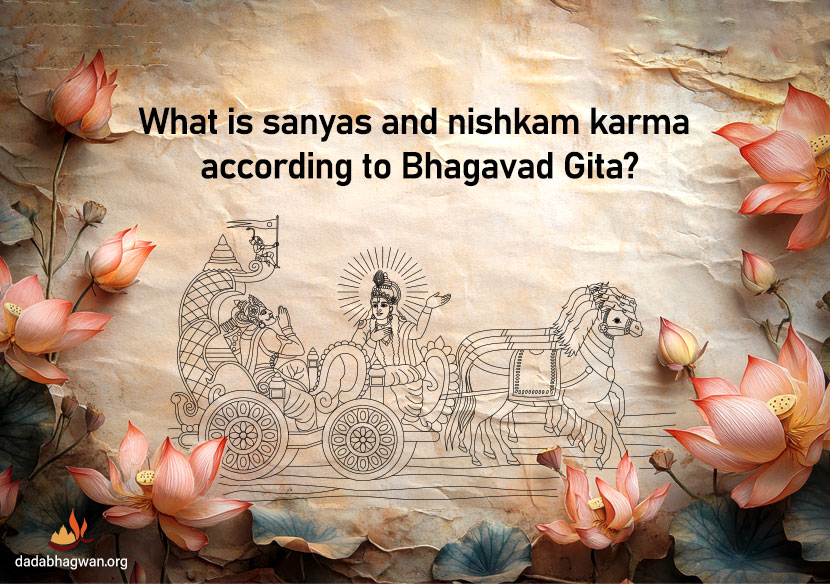
In the fifth chapter of the Bhagavad Gita, Lord Shri Krishna explains two paths to liberation; one is Sanyas (Renunciation) and the other is Nishkam Karma Yoga (to work without expectations of reward).
Sanyasah karmayogashcha nihshreyasakaravubhau |
Tayostu karmasanyasatkarmayogo vishishyate || 2 ||
Meaning, both the paths of karma sanyas (renunciation of action) and the path of karma yog (selfless action) lead to the supreme goal. However, the path of selfless action is superior to that of renunciation. Here, we shall understand the true meaning of both Sanyas and Nishkam Karma.
Sanyas (Renunciation)
In the worldly sense, renunciation is often understood as changing clothes to wear saffron robes, giving up one’s home and family, and abandoning all possessions. But according to what Lord Shri Krishna says in the Bhagavad Gita, merely giving up the worldly life is not true renunciation. The meaning of the word Sanyas, as explained by Lord Shri Krishna, is far higher and much deeper.
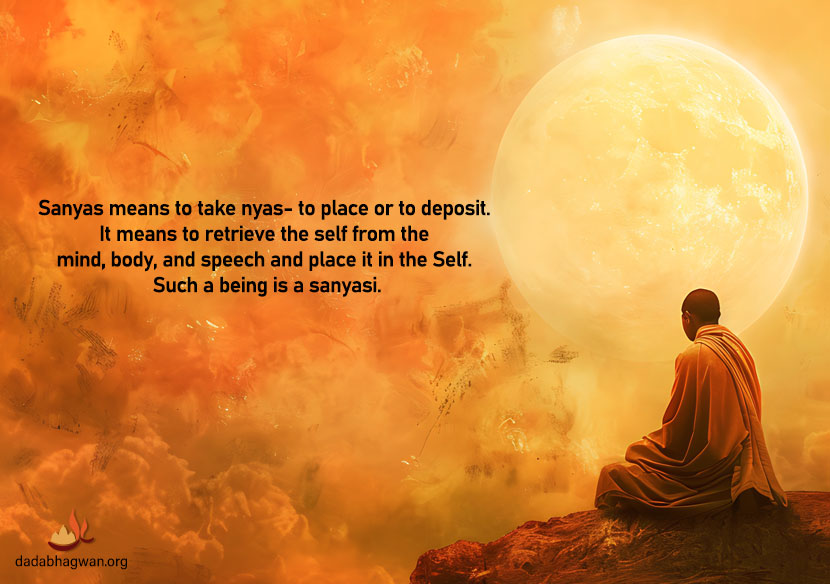
Param Pujya Dada Bhagwan, while explaining the inner intent of Lord Shri Krishna, has said that, “Sanyas means to take nyas- to place or to deposit. It means to retrieve the self from the mind, body, and speech and place it in the Self. Such a being is a sanyasi.” He explains the true meaning of sanyas by saying that when the Self is established in the Self, that is real sanyast yoga (renunciation). Going further, Param Pujya Dadashri also says that, “Sanyast yoga means to not have the awareness of ‘I am the doer’, in all that one does; this is the definition of a true sanyasi.”
That is, the person who does not live as the body, not only that but who withdraws from the five senses, mind-intellect-chit-ego, and realizes, “I am not this form, I am the Soul”, such a person who abides in the Self, is the true renunciant. A true renunciant remains constantly established in the Self, even amidst thoughts, speech, and actions, knowing, ‘I am not the one speaking these words, I am not the one thinking these thoughts, the body performs actions, but I am not in them; I abide only in the Self.’
Just as when a person is in the field, they are not at home and when they are at home, they are not in the field. In the same way, until one attains the Knowledge of the Self, one cannot dwell in the Self and therefore cannot be called a true renunciant. A complete renunciate is also known as a dharma sanyasi. Dharma sanyasi means the one who remains constantly established in the Self.
In the third verse of the fifth chapter of the Bhagavad Gita, Lord Shri Krishna describes the other qualities of a true renunciate.
Gneyah sa nitya sannyasi yo na dveshti na kaankshati |
Nirdvandvo hi mahabaho sukham bandhatpramuchyate || 3 ||
Meaning, the one who never feels abhorrence and has no desires, is to be known as a true renunciate. The person who is free from all dualities such as attachment and abhorrence certainly becomes liberated from bondage and attains peace.
Param Pujya Dadashri also supports these qualities of a true renunciate. He explains that, according to what Lord Shri Krishna said, any person who possesses the following three qualities is a true sanyasi; whether he is a householder, a monk, or anyone else.
1. He does not have the pride of doer-ship.
2. He does not have any infatuation.
3. He has no desires.
Nishkam karma (that which is done without the expectation of a reward)
In the second chapter of the Bhagavad Gita, Lord Shri Krishna says that,
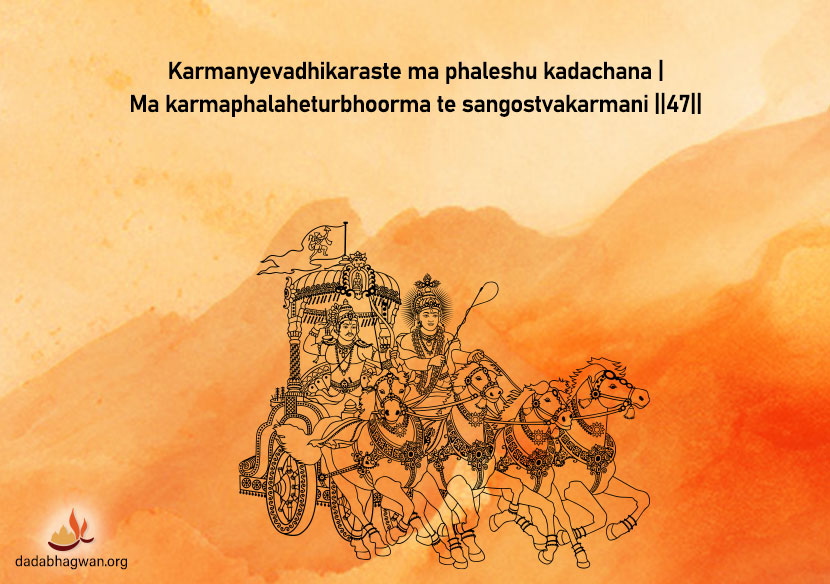
Karmanyevadhikaraste ma phaleshu kadachana |
Ma karmaphalaheturbhoorma te sangostvakarmani ||47||
That means you have the right to only perform your actions, but never to the fruits of those actions. Never consider yourself to be the cause of the results of your deeds, and never become attached to inaction.
In the world, this verse is generally understood to mean that selfless action means performing one’s duties without expecting any results. However, people often find it difficult to understand the deeper, hidden meaning of what Lord Shri Krishna truly intended.
Param Pujya Dada Bhagwan, explaining the essence of nishkam karma in the simplest language, says that, “People say nishkam yoga means, “Do what you have to do, but without any expectations of any reward.” Well, not even a bug would leave its home without any expectation! No one would do any work without some expectation of a reward! Would anyone go to a shoe store without expecting to buy a pair of shoes? No one would go to the market if he knows he will not be able to buy any vegetables today. Nevertheless we have to say, “Do your work without expectations for a reward.” What this does is, while working, this statement will remind you, ‘The Lord has said to work without expecting a reward,’ and because of this, the reward will be good. If people could truly work without expecting rewards, they would make progress, but they have not understood what Lord Krishna is saying. What the Lord said was, “When you go to buy vegetables, expect to get vegetables, however, having bought them, if they turn out bitter, then that is your reward. Therefore, do not have expectations for the rewards and do not do raag-dwesh. Accept whatever happens in the end.” Maintain composure if your pocket gets picked. Do not lament over it. Maintain equanimity there. If you go out to buy a sari, naturally you expect to get a sari, but do not get depressed if it turns out to be a bad one. Accept the sari as it is. Do not expect anything more than that. Do not do raag-dwesh; that is what Lord Krishna is trying to say. You can go to a shoe store but do not harbor feelings of right or wrong, likes and dislikes. Therefore, nishkam karma is to not harbor like or dislike in the result of any effort.”
In a question and answer satsang with Param Pujya Dadashri on nishkam karma, this topic was explained in great detail. In response to the question, “How can one become nishkaami (selfless)?”Param Pujya Dadashri says, “Do your work without thinking about the results. Continue working without worrying, whether or not your boss will reprimand you or get upset with you. If you decide to take an exam, then do it without worrying or thinking about whether you will pass or not.”
Param Pujya Dadashri gives another example and explains, what is called nishkam karma? Say for instance, every month we receive income from our household, land, and business. Now suppose we assume that every month we will receive twenty to twenty-five thousand rupees, and then due to changing circumstances we get only five thousand, we feel as if we have incurred a loss of twenty thousand. But what if we had not made any assumptions at all? Nishkam karma means to keep doing your work without expecting or assuming any specific result in return.
Param Pujya Dadashri says that, “Lord Krishna has given people a very wonderful thing, but is it possible for anyone to achieve this? People are not capable of this. It is very difficult to understand nishkam karma precisely. That is why Lord Krishna said that there might be just one or two persons who would understand the subtlest meaning of the Gita.”

subscribe your email for our latest news and events
Dada Bhagwan Foundation, Adalaj is a spiritual non-profit organization whose goal is to spread peace, harmony and everlasting bliss to the whole world through the spiritual science of Akram Vignan.
Ask a question and Get an assured response


