


What is Brahmasambandh?
The word Brahma is from Sanskrit and it means the Soul. Brahmasambandh means a permanent bond with Brahma, that is, with the Soul. To remain constantly aware of one’s own inner Self is called brahmasambandh. Wearing a sacred necklace or receiving a mantra in the ear is a ritual of worldly life, but the true brahmasambandh is when one forms a real connection with one’s own Soul.
Param Pujya Dadashri gives the definition and characteristics of brahmasambandh.
Dadashri: When one experiences bliss of the Self within, then the intense desire to know the Lord within increases, and thereafter, the connection with the Lord is established (brahma sambandh). When he does not forget the Lord within for even a second, that state is called brahmasambandh. Then one will not have any worries.
Shri Krishna Bhagwan has not spoken anywhere in the Bhagavad Gita about brahmasambandh; He has only spoken to Arjun about knowing the Self. He spoke only of Atma Gnan (Knowledge of the Self), which is beyond Jain or Vaishnav religions, beyond sects and traditions, and even beyond this body! Later, Acharya Shri Vallabhacharya affirmed and gave recognition to the true brahmasambandh. Once we take refuge in our own Self, we no longer need any other refuge; we don’t need to search for happiness anywhere else—this was the true meaning. But with time, the real meaning has been forgotten. If we have truly attained the eternal refuge of the Self, we should not seek other support. But what about those who have not attained that refuge at all?
This deceitful world, which is actually a storehouse of endless suffering, does not contain even a trace of happiness. Because of illusory attachment (moh), the world appears pleasant, but once that illusion fades, it tastes as bitter as medicine. Therefore, one should form such a bond with the Self and with the Atma Gnani (the Self-realized One) who helps us recognize the Self, a bond that never breaks. Then, with the vision they give, one develops a firm connection through which pure Soul is seen everywhere, in trees, leaves, animals, and birds.
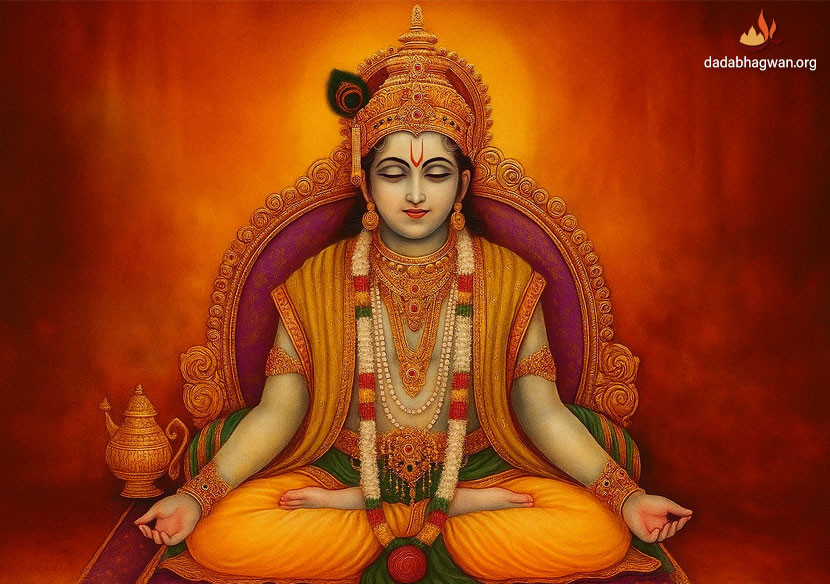
Beyond brahmasambandh lies the state of becoming Brahma swaroop (the Self) itself. Lord Shri Krishna had attained the state of Parbrahma (the absolute Self) which is known as the state of the absolute God, or Bhagwanpad. Shri Krishna transformed from an ordinary human into Narayana. The form in which we usually recognize Shri Krishna such as playing the flute, wearing a peacock feather, or as Arjun’s charioteer, He Himself negated these forms in the Bhagavad Gita. In the Bhagavad Gita, Lord Shri Krishna tells Arjun that “the form in which you see me in, that is not my real form. My true form is the Self (Atma). You too are the Self, and so is everyone. See all beings in their Atma-form.”
Param Pujya Dada Bhagwan says that He Himself is the Supreme Self, but until one attains that state, one holds on to worldly religion or the form of God in the heart. But as long as the real Self is not attained, that is only a belief. When one attains one’s own true Self, that is called brahmasambandh.
Lord Shri Krishna revealed to Arjun, step by step, the path to becoming Brahma swaroop, that is the Atma swaroop. He asks us to walk on that very same path step-by-step. The Self that Lord Krishna made Arjun realize, realizing that same Self, and attaining the state of akarma (not charging karma) even while performing actions, this is the path that has been shown in the Bhagavad Gita. Just as Lord Shri Krishna did, a Gnani Purush can lift our faith away from the world and establish it firmly in the one Self, in Brahma, thereby making Brahmanishtha (established in God). Param Pujya Dadashri gives a beautiful explanation of this here.
Dadashri: “Mun vachan kaya thhi taddan joodo evo, Brahmasambandh vado hu Shuddhatma chhu.” (“Completely separate from the mind, body and speech; I am the pure Soul with the connection to the Supreme Soul.”) This mantra will sustain your state of the Self, while improving interactions of worldly life. Thus it will also preserve and protect you from slipping into negative worldly interactions. This mantra sustains the Self and increases the connection with the Self. A yearning to be with the Gnani Purush is Brahmasambandh. You have been friends with maya (deceit; illusion) for so many lives that it will come back even if you were to get rid of it. However, with the establishment of Brahmasambandh this illusion, maya will leave forever.

subscribe your email for our latest news and events
Dada Bhagwan Foundation, Adalaj is a spiritual non-profit organization whose goal is to spread peace, harmony and everlasting bliss to the whole world through the spiritual science of Akram Vignan.
Ask a question and Get an assured response


