


What is Michhami Dukkadam?
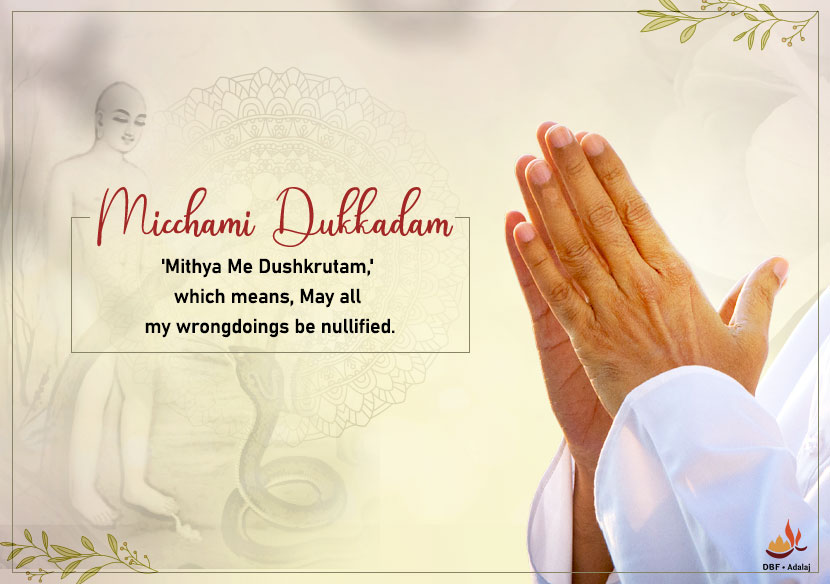
Michhami Dukkadam is a word from Ardhamagadhi, a Prakrit language derived from Sanskrit, which was used by Lord Mahavir to deliver His spiritual discourses. The phrase Michhami Dukkadam literally translates to 'Mithya Me Dushkrutam,' which means, May all my wrongdoings be nullified. In essence, these words express a profound prayer: “May every kind of negative action or hurt I have caused, be dissolved and made fruitless.”
What qualifies as wrongdoings? It includes any action that causes even the slightest bit of pain or suffering to any living being; for all such actions, practicing pratikraman (to confess, apologize and resolve not to repeat a mistake) is absolutely essential. Furthermore, it also applies to occupations that involve unavoidable, direct harm to living beings such as trading in agriculture or groceries, where insects and tiny organisms are inadvertently harmed. Even if we have no desire to do it but are forced to fulfill it as a duty, we should never take pleasure in it. Instead, we must practice pratikraman and pray, "Oh Lord! Why did this task fall to my lot? I deeply regret it."
From this deeper meaning, it becomes clear that “Michhami Dukkadam” is not just a greeting to be casually passed around once a year on Samvatsari (annual pratikraman ceremony), like wishing someone a Happy New Year. Instead, these words are meant for recalling our mistakes and expressing genuine repentance for them. That very repentance is the essence of the pratikraman performed on the day of Samvatsari.
A question might also arise in our minds, 'If we commit mistakes all year round, why do we perform pratikraman on just a single day?' Gnani Purush Param Pujya Dada Bhagwan explains to us here what authentic pratikraman truly means and what kind of pratikraman Lord Mahavir actually spoke about.
Bhaav Pratikraman
True pratikraman is when we think, 'This mistake that I am committing is wrong; it should not be this way’. Our intent should be such and our perspective toward that mistake should completely change. For instance, if we happen to lash out at someone in anger, then deeply repenting for it and firmly resolving never to lose our temper again is what pratikraman truly means. Simply memorizing and reciting the verses written in the scriptures does not genuinely wash away our faults. Just because a parrot learns to chant 'Ram-Ram,' does that bring it liberation? So, just by saying Michhami Dukkadam without understanding it or feeling remorseful, will your wrongdoings be washed away?
The pratikraman that takes place nowadays is mostly what is called dravya pratikraman i.e. gross pratikraman performed simply as a superficial ritual. In dravya pratikraman, there is merely the act of reciting memorized words without actually identifying one's mistakes; because the feeling of genuine repentance is missing, it lacks any real impact. For example, if we keep repeating, “I have eaten, I have eaten”, will that actually fill our stomach? To take another example, suppose a scripture outlines a process, saying: “In the old days, people used a 501 brand’s soap, which was 12 inches long, 2 inches wide, and 1 inch thick. Then they would take the dirty clothes, soak them in water, apply the soap, and wash them.” Now, if we just sit down for an hour once a year and chant this method over and over, will it wash the dirt out of our own clothes? Of course not! To do that, we actually have to take the soap and sit down to wash our clothes. It is just like drinking a topical ointment that the doctor prescribed for external application, not only will it fail to cure the disease, but it will end up poisoning you. Therefore, it is bhav pratikraman (reversal of aggression in thoughts, speech and action by changing the inner intent), done by truly understanding the underlying intent of the Tirthankara Lords, that qualifies as authentic pratikraman.
Pratikraman in one’s own language
We must practice pratikraman exactly where we committed the fault, where the atikraman (to hurt any other living being through the mind, speech, or body) occurred, as this is what actually dissolves the mistake. If we give directions in Gujarati to someone who only speaks French, will they ever reach their destination? They won’t. In the exact same way, since we do not understand the Magadhi language today, simply memorizing and reciting verses written in it will not result in true pratikraman.
For one, when pratikraman is performed in the Magadhi language, and on top of that, when someone else is reading while we are just listening, how can the mind remain focused? It is a natural law that the chit only sticks to things that truly interest us. Think of it like teaching a child: if they make a mistake while solving a math problem with a pencil, they use an eraser to rub it out, right? In the same way, if we cause someone pain, simply asking for their forgiveness erases our fault. If we ask for forgiveness in simple words, in the language we actually speak, saying, “I made this mistake, I ask for your forgiveness, I will not do this again”, then the pratikraman is complete.
Instantaneous Pratikraman
Param Pujya Dadashri says that a truly discerning or astute person is one who reflects at every single moment: 'What just happened? What just happened?' and performs pratikraman the very instant a fault occurs. A discerning person immediately realizes when a mistake has been made with someone like if a word came out a bit too harsh while speaking to them and asks for forgiveness right away. Or, if a clash occurs with someone, or even if a negative thought pops up about them, they perform pratikraman right then and there, on the moment, by recalling that person. If we practice this kind of 'shoot-on-sight' pratikraman, our faults will leave us. If, instead, we sit down on the day of Samvatsari to clear twelve months' worth of faults all at once, do you think we will remember even a single one of these small, everyday mistakes? How can they ever be washed away!
Explaining the inner heart and true intent of Lord Mahavir, Param Pujya Dadashri says in deeply compassionate words, “What He said was, “if you stumble, then realize that you must have erred and therefore immediately do alochana (confession of misdeeds) to your Guru or with me as your witness.” This pratikraman has to be done directly, immediately and on a one-on-one basis; only then will you be able to wash away the mistake, just as you are quick to wash the stains on your clothes, to prevent it from setting in. Human beings are like this, if they spill tea on their clothes, they will rush to wash off the stain, whereas they have no care about washing off the stains that have tainted their minds from countless past lives.”
What lies in the heart of the Tirthankara Lords
In truth, the path shown by the Tirthankara Lords was quite different. First they instructed us to perform pratikraman instantly, the very moment a mistake occurs. If you cannot do that, then just as we clean the dust from our homes daily, you should sweep away your inner 'trash' twice a day, once in the morning and once at night. Back then, out of a thousand disciples, two would be such that they’d come forward and ask, “What if we cannot manage to do pratikraman every morning and evening?” To them, the Lord said, “Then do it once a week.” Later, he suggested Pakshik (once every fifteen days). When people were found who couldn't manage even that, the Lord showed a path to do it once a month, and then once every four months. Finally, when there were still those who could not keep up, the Lord stopped here: Perform pratikraman once a year on the day of Samvatsari. This was because as time passed, human spiritual capacity grew weaker. The kashayas, the inner passions of anger, pride, deceit, and greed increased so much that the Lord hoped that if a 'brake' could be applied to these faults even once a year, there would at least be a way for the soul to turn back.
In reality, what should pratikraman look like? If a merchant or businessman has committed faults like short-changing the weight, cheating, or adulterating goods in their business, they must recall all such mistakes made throughout the day on a daily basis, feel genuine remorse, and resolve never to repeat them. For instance, they must perform a separate pratikraman for 'giving a gentleman less grain than he paid for,' a distinct pratikraman for 'foisting bad quality salt onto this lady,' another pratikraman for 'selling adulterated oil to that person,' and a pratikraman for 'getting into an argument or conflict with the shop employees.' Every single fault must be recalled and dissolved through individual, specific pratikraman. In the exact same way, one must sincerely perform pratikraman by recalling every fault committed from the moment they wake up in the morning until they go to sleep at night with family members, between husband and wife, with children, with a boss or an employee, or with any person close to them.
On top of that, we go to perform pratikraman dressed in brand-new clothes as if we are off to enjoy ourselves at a wedding, without a single drop of actual remorse in our hearts. As a result, instead of reducing, our faults keep multiplying. Even after spending thirty or forty years of one's life performing these rituals, if the underlying intent or purpose behind them is not understood, then the entire action goes to waste!

subscribe your email for our latest news and events
Dada Bhagwan Foundation, Adalaj is a spiritual non-profit organization whose goal is to spread peace, harmony and everlasting bliss to the whole world through the spiritual science of Akram Vignan.
Ask a question and Get an assured response


