


How to get rid of bad karma in this Life?

A terrible time is approaching. Intense suffering lies ahead! The result of excessive atikraman (to hurt any other living being through the mind, speech, or body) is rebirth in the animal realm, and if the atikramans are even more severe, then that will result into the life-form in hell. Corruption, adulteration, and enjoying what one has no rightful claim over all of this is considered pashavata (animalistic). To suffer the consequences of such actions, one must take birth in an animal life-form. Even here, however, if we use the weapon of pratikraman (to confess, apologize and resolve not to repeat a mistake), there remains some chance of being saved. Thus, it becomes necessary to know how to get rid of bad karma.
No matter what kind of sins may be stored in the vessel of one’s life, through sincere repentance it becomes lighter. Some sins are even completely burnt and eradicated. If a mistake has occurred, and one deeply repents, again and again with true remorse, then that fault will certainly be erased.
If even the slightest amount of suffering is caused to any living being, paap (demerit) karma is bound. Therefore, wherever suffering has been caused, one must definitely do pratikraman. Here, we will come to understand the different ways in which demerit karma gets bound, and learn how to do pratikraman for them, which is the answer to how to get rid of bad karma in this life.
Pratikraman for gross violence
Among all forms of violence toward living beings, sthool (gross; physical) violence causes the greatest suffering. For example, in farming, when pesticides are sprayed to protect crops, countless living beings are killed, and the demerit karma is bound as a result. Therefore, those engaged in farming should, every day for five to ten minutes, pray to God that, “Through the process of farming, whatever violence has occurred toward living beings, I do pratikraman for that. Please forgive me.” By doing so, the burden of the violence is reduced.
If unknowingly an insect has been crushed under one’s foot, if an animal has come under a vehicle, or if knowingly we have killed any insect, creature, or bird, then all such forms of violence should be recalled and pratikraman should be done for them. At the same time, one should firmly resolve in the mind, “I do not want to kill any living being.”
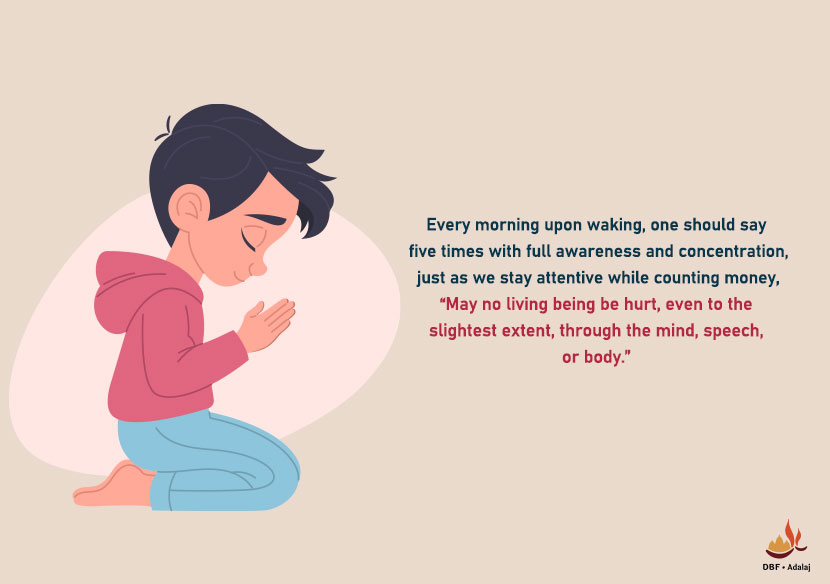
In cases of violence that happened unknowingly, one should not remain careless by thinking, “How was I supposed to know? How much can I really avoid?” Every morning upon waking, one should say five times with full awareness and concentration, just as we stay attentive while counting money, “May no living being be hurt, even to the slightest extent, through the mind, speech, or body.” This is one of the most practical tips to how to get rid of bad karma.
Pratikraman for violence caused by the kashays
Hurt caused through inner passions such as anger, pride, deceit, and greed, or through impure sensual and corrupt thoughts, is called sookshma (subtle) violence. If, through our thoughts, speech, or behavior, we act in a way that causes even the slightest hurt to someone, especially if the other person experiences clear, direct pain, then that is atikraman, and pratikraman must definitely be done for it.
Even if someone does not appear to be outwardly hurt, but carries inner, unexpressed pain, pratikraman should be done for that as well. When someone insults us, we may remain silent outwardly, yet retaliation continues in the mind, retaliation may also happen through speech, and even through the body. When these three forms of inner weakness arise, pratikraman must be done in all three ways.
If someone feels fear because of us, behind it lies our intellect and ego. When our intellect becomes overactive and we make strong, forceful decisions in matters, the other person can become intimidated. Even if we apologize today, the echoes of the past may still remain, and it takes time for them to fade. Therefore, we should keep remembering all such instances and continue asking for forgiveness. If any hurtful interaction has occurred, we should search within to see which of our kashays (inner enemies of anger, pride, deceit and greed) were at work behind it. We should recognize our insistence, expectations, prejudices, the accusations we have placed on others, what we were determined to make happen according to our own will, and identify our own pride, greed, and attachment.
If we go to a restaurant to eat and we end up breaking a dish, instead of admitting our mistake we cover it up and blame the other person by saying, “Your staff wasn’t paying attention, they broke it!” Or if we become angry at someone and later justify it by saying, “He was lying, so I had to get angry.” So all of this is called atikraman. All such instances require pratikraman. Even at home if the tea turns cold, a hot snack is not prepared, the meal is not ready on time, or children do not act according to what we say, we react with anger. That causes hurt to others. Pratikraman should be done for all such situations to proceed promptly on the path of how to get rid of bad karma.
Heavy demerit karma is also bound through actions that involve acquiring wealth without rightful claim. In business, charging excessively high prices for greater profit, lending money and taking excessive interest, not repaying what is owed, buying or selling black-market goods, evading taxes, taking bribes or commissions, all of these cause suffering to others. As far as possible, one should avoid engaging in wrongful activities. Even so, if under pressure one is compelled to do them, then if circumstances allow, one should change one’s line of work. And if circumstances do not allow that, then one should sit for one hour and repent and work on making corrections inside. Gradually, the external circumstances too will begin to change.
In addition, if impure sensual thoughts arise toward someone else’s spouse, or if immoral thoughts arise in the mind, one should cleanse them through pratikraman. If one has indulged in sensual relations outside the rightful bond of husband and wife, it binds extremely severe demerit karma, leading to birth in the animal realm or the hellish life-form. One should be especially vigilant about this, and with heartfelt repentance for such faults, turn back from them, which is a mandate when it comes to how to get rid of bad karma.
Pratikraman for hurting others through speech
Param Pujya Dadashri says that in this current era of decline, bondage is created mainly through speech, and to speak wrongly to someone is like throwing dust upon one’s own Soul.
In worldly interactions, if we attack someone through speech, it is considered aggression. It causes hurt to the other person, and therefore pratikraman must be done for it. If someone gently points out our mistake, we suddenly lash out saying, “Let me warn you, don’t get after me! Who do you think you are?” and so the other person is silenced. Saying things like, “Look at your own faults, why are you after me?” is considered an attack through words. Speaking words that break someone’s heart or shatter their ego, speaking in a harsh or loud tone, insulting someone, using sharp intellect to find others’ faults and wound them with words, or placing serious accusations on someone’s character or honesty, all of this is considered a very heavy attack. Such actions damage worldly relationships and can also cause the other person to bind deep resentment or enmity.
Even if we lightly make fun of someone especially when the other person is in a weaker position and unable to respond, it still causes them inner hurt. Param Pujya Dadashri says that the danger in mocking someone is infinitely greater than even striking them physically. The reason is that in jokes and ridicule, the other person’s intellect cannot defend itself, while we wound them through our intellect. Therefore, wherever we have hurt someone through speech, we should recall all such faults, ask for forgiveness, and feel heartfelt repentance for them.
If we discuss someone who is not present and speak negatively about them, that becomes raudradhyan (adverse internal state of being/meditation that hurts the self and others). The vibrations of such thoughts and words do not remain without giving their effect. If we say about someone, “He is crooked,” or “He is worthless,” then after a couple hours that person will not feel love towards us, a divisiveness arises. Pratikraman should be done for that, which is indispensable when it comes to how to get rid of bad karma of hurting others through speech.
In worldly dealings, even if we insist on “truth” and speak harshly, or say something that challenges another person’s beliefs in a way that hurts them, pratikraman should still be done. Each person considers their own viewpoint to be correct. If we declare their viewpoint to be wrong, it causes them pain. What seems right to us may appear wrong from the other person’s perspective. Param Pujya Dadashri says that true speech is that which does not lead to conflict or clash, and which the other person is able to accept.
No matter how noble or golden our intention may be, if our speech causes hurt to someone, pratikraman should be done, because we cannot become happy by giving pain to others. If we need to correct or point something out to someone for their benefit, it should not be done in a hurtful way, but with love and humility. Even for such admonishment, pratikraman should be done.
Pratikraman for spoiled inner intention (Bhaav)
If a thought arises that may cause harm to another, it is called raudradhyan (destructive meditation) and the thoughts that revolve around harm to oneself are called aartadhyan (adverse internal state of being that hurts the self). Whenever aartadhyan or raudradhyan occurs, pratikraman should be done for it. When inner feelings become disturbed toward someone, when we feel agitation upon merely seeing a person we dislike, or when even while watching TV or reading the news we develop negative feelings toward a bunch of people, pratikraman must be done for all of those. Constant worry, anxiety about the future such as, “Will my daughter get married or not?”, or when ill, “What will happen if I die?”, or upon receiving an income tax notice, “What will happen now?” such thoughts fall under aartadhyan and they bind karma that leads toward a lower state of existence. Therefore, pratikraman should be done for them, a necessary step to how to get rid of bad karma caused due to aartadhyan.
Let us take an example of how inner intentions spoil. Suppose we are preparing to go to sleep at around 11:30 at night, and someone knocks on the door. When we open the door, we see that a group of ten to twelve people has arrived. One or two may be known to us, and the rest are acquaintances of theirs. Now at that time, outwardly, since guests have come we say, “Come in, please sit.” But inwardly, our feelings get disturbed, “Where have they come from at this hour?” Then we politely say, “You’ve come from far away, would you like some tea…” - and before we can finish, the guests say, “Forget the tea, just make some khichdi and kadhi, that will be enough.” Therefore the woman handling the kitchen becomes agitated. Externally, we maintain good social behavior so that nothing appears wrong, but internally we keep thinking negatively.
In Indian culture, it is said, “Atithi Devo Bhava”, a guest is like God. An atithi is one who arrives without prior notice, without a fixed date (tithi). If negative feelings arise toward such guests, then pratikraman should be done like, “O Lord, due to the pressure of circumstances, wrong feelings arose within me. This is not my true intention. I ask for forgiveness. These guests are most welcome.” And the women of the household, too, should serve them food humbly. Because once guests have arrived, there is no remedy for the situation and they shouldn’t be sleeping with an empty stomach.
If, after hearing negative things on television or in the news about any religion or religious guru, we have criticized them or developed negative inner feelings towards them, that too should be recalled and cleansed through pratikraman. One should do pratikraman in this way: “In this life, in past lives, in countless past lives, in innumerable past lives, and in infinite past lives, whatever disrespect or offense I may have committed or caused toward religion, monks or nuns, or spiritual leaders, for that, in the presence of the God (or a chosen deity in whom you have faith), I ask for forgiveness. Grant me the strength that not even the slightest offense occurs again.”
Param Pujya Dadashri says that, “There is no accountability on your part in saying someone is good when he is good, but there is a liability in calling someone bad when he is good, and there is also liability in calling a bad person, bad; tremendous liability. Because, in reality, he is never bad; it is his prarabdha (karma effect) that makes him appear bad.” In reality, no living being truly has the intention to do wrong. Circumstances compel them to act in wrongful ways. This is a very great key to seeing others as innocent.
If we do pratikraman for the person toward whom our mind feels flustered, the hatred eventually comes to an end. The inner turmoil we experience because of that person also gradually stops. Every night, we should review the entire day, whoever’s faults we may have seen, wherever our inner feelings became disturbed and do pratikraman for each of them, clearing the inner ledger completely. Param Pujya Dadashri says that, “When you suffer through something that you dislike, with a clean mind, you will become vitarag.” A pure mind is one in which not even the slightest negative thought arises toward anyone; and if it does arise, we immediately wash it away through pratikraman.
All these pratikramans are essential, which form an integral part of how to get rid of bad karma in this life.
Here, Param Pujya Dadashri explains how long pratikraman should be done in order to wash away demerit karma.
Questioner: How am I to wash away my paap (demerit karma; wrong actions) karma now?
Dadashri: For each stain (demerit, paap karma) you should do pratikraman. If any stain is stubborn, then it will need to be washed over and over again.
Questioner: How can I tell whether the stain is gone or not?
Dadashri: You will know when your mind becomes clean from within. Your face will glow. There will be a natural smile on the face.
Furthermore, pratikraman should be done for as long as a fault continues to prick us from within. For example, if we lie down on a mattress and there are pebbles underneath, we remove them from wherever they poke us. In the same way, for whichever faults continue to trouble us internally, pratikraman should be done specifically for those.
After doing pratikraman, we may feel, “Why is there no change?” There is a reason for that too. If we commit a thousand faults but do only ten pratikraman, it will seem as though nothing has improved. In a single incident, if the mind turned negative a thousand times, how many times did we turn it back in the right direction? If a drop of tea falls on clothing, can it be cleaned with just one drop of water? In the same way, to wash away one fault, many pratikraman are needed. Moreover, in this era of Kaliyug (an era of the time cycle characterized predominantly by misery, and almost no happiness), karmas are very sticky. Therefore, we should set aside more time to do pratikraman and pratyakhyan (to make a resolve to never to repeat a mistake and ask for the energies for the same). Then we will experience that the stickiness has been washed away and our worldly interactions have become pure.

subscribe your email for our latest news and events
Dada Bhagwan Foundation, Adalaj is a spiritual non-profit organization whose goal is to spread peace, harmony and everlasting bliss to the whole world through the spiritual science of Akram Vignan.
Ask a question and Get an assured response


