


What are the different types of charity?
There are four main types of charity.
The first is aahaardaan (donation of food), the second is aushadhdaan (donation of medicine), the third is gnandaan (donation towards Knowledge that helps one progress on the path of liberation), and the fourth is abhaydaan (when one conducts oneself in such a way that does not cause fear in or hurt any living being).
1) Aahaardaan
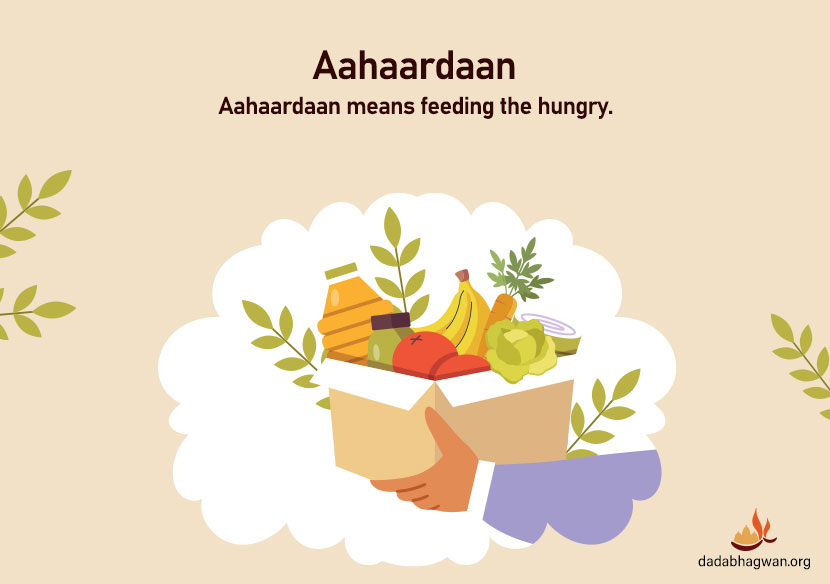
One of the most popular kinds of charity is aahaardaan (donation of food). Aahaardaan means feeding the hungry. Nowadays, many religious organizations and volunteers actively work with the noble intention of providing meals to the hungry in their communities or cities. Some organizations serve food free of cost, while others provide it at a subsidized rate to prevent food wastage. All such types of charity are considered a part of aahaardaan.
If someone approaches us saying, “Please give me something. I’m hungry,” and we offer them food, it is considered aahaardaan. Many times, people offer leftover food from their homes to beggars. Even in such cases, it is good that the surplus food is being put to meaningful use. But truly, cooking fresh food and feeding the hungry is on an entirely different level! If someone comes to us hungry, we should immediately offer them whatever freshly prepared food we have.
Generally, food donation is for only for a single meal, it isn’t permanent. Param Pujya Dada Bhagwan says that feeding a hungry person is equivalent to giving them the gift of life for one day. If someone eats a full meal, their hunger is satisfied; then they can live through that day. We need not worry about who will feed them tomorrow. Whether we can offer food regularly or not, if someone comes to us asking for it, or if we notice someone hungry, we should feed them to the best of our ability.
2) Aushadhdaan
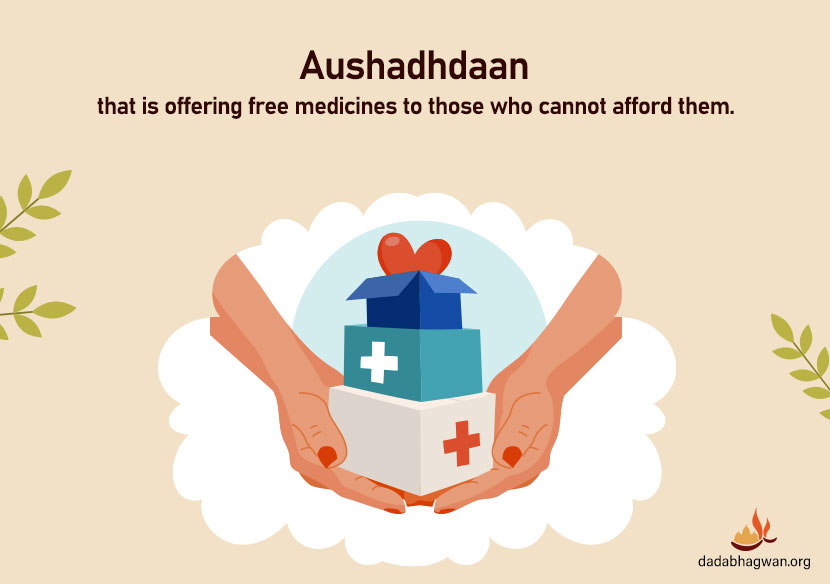
The second type of charity or donation is aushadhdaan; that is offering free medicines to those who cannot afford them. aushadhdaan is considered nobler than aahaardaan.
What happens through aushadhdaan? Suppose a person from a modest household falls ill and visits a doctor, who gives them a prescription. But if they don’t have the money to buy the medicine, what can they do? They simply don’t buy the medicine. If the illness worsens, it can even lead to the death of that person. If we come across someone in such a situation and either give them money to buy medicine or provide the medicine ourselves without taking any payment in return that is called aushadhdaan (the donation of medicine). Some clinics and hospitals also provide medical treatment and medicines to such individuals at concessional rates, this too, is considered aushadhdaan.
Through aahaardaan, a person receives the gift of life for a day or two. But through aushadhdaan, if the person recovers, they may go on to live for months or even years. A donation made in the form of medical treatment or medicine, grants a person health and helps them live longer. Moreover, it frees them from physical suffering during that time. Therefore, these different types of charity of aushadhdaan are considered more valuable than those of aahaardaan.
3) Gnandaan

The third type of donation is gnandaan (the donation of knowledge). Donating books or literature that guide people towards the right path falls under this category. It is regarded as a higher and nobler form of donation than aushadhdaan.
Publishing and distributing books that impart true understanding, guide people on the right path, and contribute to their well-being, as well as offering such books to others free of cost, all fall under gnandaan. Even providing such books at a nominal price, to ensure they are valued and not wasted, also counts as gnandaan.
If the books received through gnandaan impart the true understanding of religion, a person’s present life improves, conflicts and sorrows decrease. Moreover, in the next birth, one attains a higher state of existence. And if the book provides the ultimate right understanding, it helps one rise above happiness and sorrow, freeing oneself from the cycle of birth and death, and opening the gateway to Moksha (ultimate/final liberation from all karma). A single book placed in someone’s hands can bring about a profound transformation! Through gnandaan, not just one lifetime but many lifetimes can be uplifted, which is why it holds a very high value in the world.
Those who possess greater wealth should use it primarily for gnandaan. But what kind of knowledge should it be? It should be knowledge that benefits and uplifts people. Printing and distributing books filled with fictional or sensual content, which may entertain but ultimately lead a person toward a lower life-form, cannot be called gnandaan.
Nevertheless, even publishing religious books does not count as true gnandaan if the intention behind it is to gain fame and recognition. A genuine religious book is the one whose knowledge proves useful in real life. Otherwise, printing stacks of books that no one reads, or that people read once and set aside without applying in life has no meaning. The purpose should not be to glorify one’s own name, but to publish more books that truly help people; only then does one earn the true fruit of gnandaan. Thus, the motive behind these types of charity helps identify whether it is gnandaan or not.
4) Abhaydaan
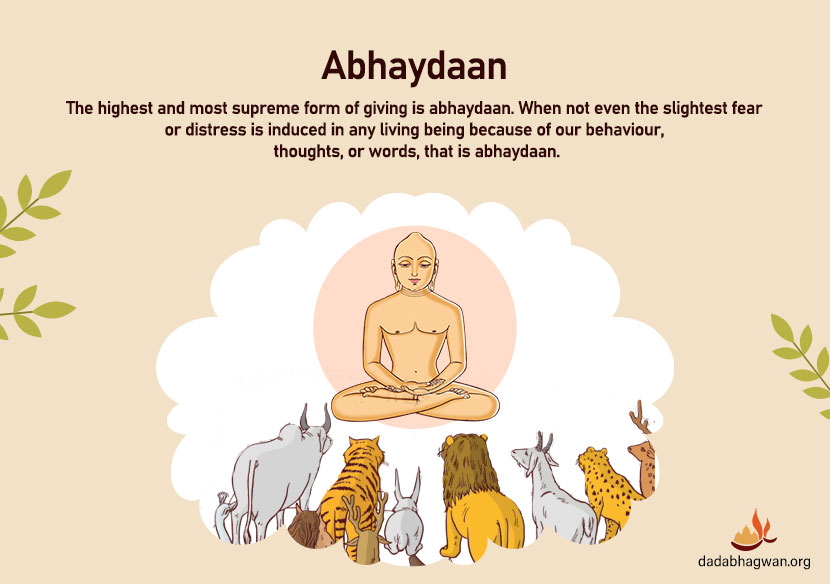
The highest and most supreme form of giving is abhaydaan. When not even the slightest fear or distress is induced in any living being because of our behaviour, thoughts, or words, that is abhaydaan. Of all the different forms of charity, it is the only one that requires no money at all.
However, giving abhaydaan is not everyone’s cup of tea. Param Pujya Dada Bhagwan Himself, even as a child, would quietly carry His boots in His hands while returning home at midnight, just so that a sleeping dog on the street would not be disturbed. That is an example of abhaydaan.
Abhaydaan does not come directly into one’s conduct. Param Pujya Dada Bhagwan explains that first one must nurture the inner intent that no living being should experience even the slightest suffering. Only then does that feeling naturally reflect in one’s actions. But if such an intent is never cultivated, how can it manifest in conduct? That is why abhaydaan is considered a very high form of charity.
The greatest of the four types of charity
Abhaydaan is the most supreme form of charity. Next comes gnandaan, followed by aushadhdaan, and lastly, aahaardaan.
Instead of directly giving money, one can practice charity through any of these four forms of donation according to the recipient’s need. In the first three types of charity offering food, medicine, or books, wealth is indirectly used.
Those with modest means should engage in aahaardaan and aushadhdaan. Those with greater wealth should contribute through gnandaan, as the gift of knowledge is considered supreme. And everyone, as far as possible, should cultivate the spirit of giving fearlessness (abhaydaan) in their hearts. Those who do not have money can still live in such a way that no living being experiences pain or fear because of them; that itself is called abhaydaan.
Any type of charity is admirable. In short, wherever there is suffering, to help ease that suffering, and to use one’s wealth for good and righteous purposes, all of that is daan.

subscribe your email for our latest news and events
Dada Bhagwan Foundation, Adalaj is a spiritual non-profit organization whose goal is to spread peace, harmony and everlasting bliss to the whole world through the spiritual science of Akram Vignan.
Ask a question and Get an assured response


