


Shree Mahavir Bhagwan: Past Lives Part-2 of the Twenty-fourth Tirthankara
We read about the first seventeen lives of Shri Mahavir Bhagwan, the twenty-fourth and final Tirthankar (the absolutely enlightened Lord who can liberate others) of this era, who lived 2,500 years ago. Now, we will see how, in His birth as Triprushta Vasudev, He committed many sinful karmas due to pride and indulgence in worldly pleasures. As a result of pouring molten lead into a guard’s ears in that life, He reaped the consequences in His final birth after taking initiation, the same soul (as the guard) struck the Lord’s ears with long thorns from a nearby shrub, causing Him unbearable pain which He had to endure for six months. In the life as a lion, by maintaining equanimity and repenting sincerely, He earned a highly elevated spiritual outcome. Now, let us read in detail about the next ten lives.
Eighteenth Birth - Tripushta Vasudev & the Nineteenth Birth
In the Bharat Kshetra (the location in the universe where planet Earth exists), a son named Achal Kumar Baldev was born to King Prajapati and Queen Bhadra. Queen Bhadra was extremely virtuous and gentle in nature. Before the birth, Queen Bhadra saw four dreams, based on which it was foretold that a Baldev (the step brother of a Vasudev Lord who is one of the 63 Shalaka Purush) would be born to her. After some time, Mrigavati, the second wife of King Prajapati, saw seven dreams. From these dreams, the interpreters predicted that a Vasudev (the one who has evolved from being an ordinary human into becoming God) would be born from Queen Mrigavati’s womb, and that he would be extraordinarily powerful and glorious. When Vasudev was born, it was noticed that three of his ribs were curved, and based on this feature, he was given the name ‘Tripushta’. Tripushta Vasudev was born during the time of Tirthankara Shri Shreyansnath Bhagwan. Tripushta Vasudev (Mahavir Bhagwan in his previous birth) learned many skills and branches of knowledge very quickly at a very young age. Achal Baldev had deep affection and attraction towards his brother Tripushta Vasudev. As is always the case with Baldev and Vasudev, they are half-brothers, yet they are bound by such deep affection that the world has never seen a bond quite like theirs, a love that remains unmatched in the entire world. After mastering many skills, both brothers grew into extremely powerful and courageous warriors.
The soul of Vishakhanandi was born in Bharat Kshetra as a Prativasudev (a rival of Vasudev, the one who has evolved from being an ordinary human into becoming God) named Ashvagriva. Ashvagriva was extremely powerful and ruled over half of the earth. A Prativasudev is always the ruler of half the world. Once, Ashvagriva asked the fortune interpreters about his death: “How will my death occur?” The interpreters replied, “It will happen due to one of two causes. First, the one who defeats and drives away your messenger, Chandveg. Second, the one who kills the Kesari lion of Sanghpur (a very ferocious lion that has killed many people and is extremely difficult to defeat), know that he will become the cause of your death.” Hearing this prediction, King Ashvagriva became deeply anxious and troubled, thinking, “What will happen now? Who will be the one to kill me?” To find this person, he sent many men to search everywhere. He also instructed his messenger Chandveg to look for the person who might become the cause of his death.
Gradually, the fame, bravery, and glory of Achal Baldev and Tripushta Vasudev, the two sons of King Prajapati, who himself was a tributary king under Prativasudev Ashvagriva, spread widely among the people. When King Ashvagriva heard about their growing reputation, he decided to test the two princes. For this purpose, he sent his messenger Chandveg to the court of King Prajapati. When Chandveg arrived in King Prajapati’s court, the music that was being played there immediately stopped upon seeing the royal messenger. The musicians stopped playing, and the messenger was respectfully welcomed and asked about his well-being and the reason for his visit. Because the joyful gathering in the court was disrupted, Tripushta Vasudev became very angry and thought, “Who is this person who has come and disturbed our enjoyment?” A Vasudev is known to be extremely powerful and also very proud. When someone disrupts their pleasure or pride, it greatly provokes their anger. Although Tripushta Vasudev could not say anything in front of King Prajapati, he firmly decided, “For disturbing my enjoyment, I will surely deal with him later.”
King Prajapati received the messenger with great respect. As tribute, he presented him with many precious jewels, elephants, and horses, and then formally sent him off. As soon as the messenger Chandveg departed, Achal Baldev and Tripushta Vasudev followed him. They caught up with him and severely beat him. Afterwards, Chandveg went back to Prativasudev King Ashvagriva and narrated everything that had happened. Hearing this, King Ashvagriva realized that Tripushta Vasudev might be one of the two causes of his predicted death. However, he still wanted stronger confirmation, so he decided to test the matter further.
King Ashvagriva devised another plan. The Kesari lion was an extremely ferocious lion. In Ashvagriva’s kingdom, there was a region where this lion killed anyone who entered and did not allow people to cultivate the land. The Ardha-Chakravarti king has 16,000 tributary kings under him. Ashvagriva ordered all his 16,000 tributary kings, one after another, to go with their armies and guard that region from the lion. Technically, it was not yet the turn of Tripushta Vasudev, but to further confirm his suspicion, King Ashvagriva deliberately sent him earlier. At that time, Achal Baldev and Tripushta Vasudev said to their father, King Prajapati, “Father, we will handle everything ourselves. We do not need an army. We will manage it. What great task is it to kill a lion!” With this confidence, the two brothers set out. When they reached the place, the people there told them, “You will have to stand guard here for one year. If the lion appears during that year, then you must kill it.” Hearing this, Tripushta Vasudev thought, “Who will wait for an entire year! Show me where the lion lives. In which cave does it stay? I will finish it right now.” Then Tripushta Vasudev went with his charioteer to the cave where the lion lived.
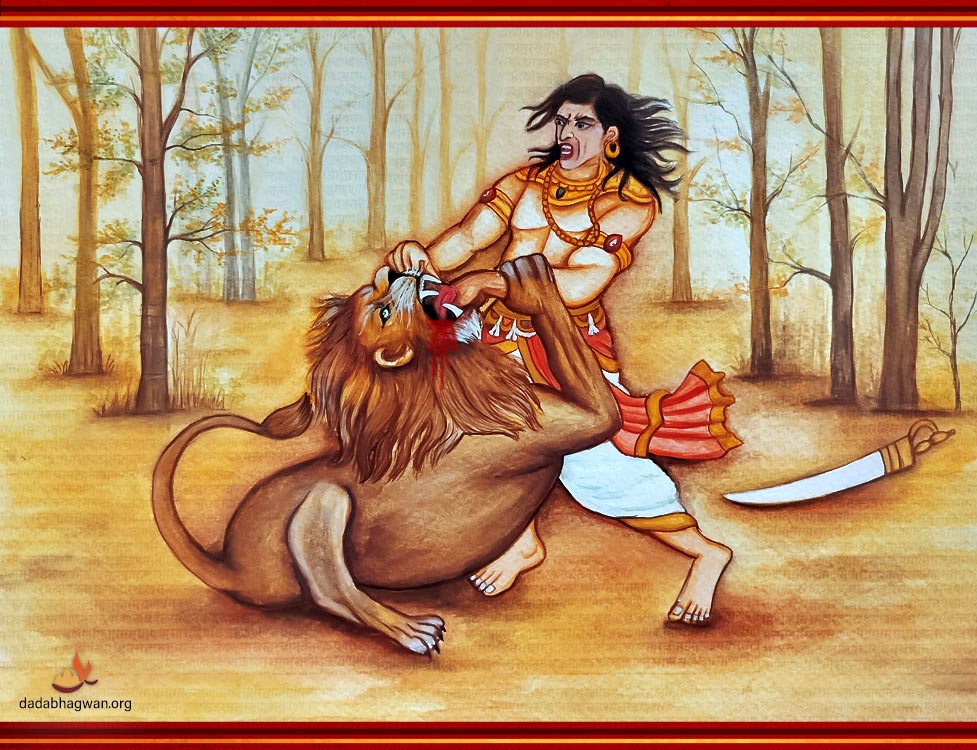
As they reached the cave, the lion came out from inside. When Tripushta Vasudev saw the lion, he noticed that the lion had no chariot; therefore, he stepped down from the chariot. At first, he took up his weapons to fight the lion, but then a thought arose within him: “This lion has no weapons except its teeth and claws. I am a Kshatriya and a king. A Kshatriya does not attack an unarmed opponent with weapons, nor does he strike from behind.” Thinking this, he threw aside all his weapons. At that moment, the lion leapt forward to attack him. In a single instant, Tripushta Vasudev caught the lion’s jaws and tore its mouth apart into two pieces. The lion began to struggle in pain. While the lion still had a few moments of life left, Tripushta Vasudev’s charioteer spoke to it, saying, “Do you know in whose hands you are dying? This is Vasudev, the ruler of half the earth, and in the coming cycle of time, he will become the last Tirthankar, Lord Mahavir. Therefore, you have not died at the hands of an ordinary being; your death has become blessed.” Hearing these words, the lion attained inner peace and left its body with equanimity. That charioteer, in the time of Lord Mahavir, was born as Ganadhar (principal disciple of a Tirthankar Lord) Gautam Swami.
When King Ashvagriva heard about this incident, he became fully convinced that Tripushta Vasudev would indeed be the cause of his death. Meanwhile, hearing of the great valour and heroic deeds of Tripushta Vasudev, the Vidyadhar King Jvalanajati decided to wed his daughter Swayamprabha to him. When Ashvagriva learned about this, he felt deeply offended and thought, “Why has Swayamprabha’s marriage been arranged with Tripushta Vasudev instead of with me?” However, Vidyadhar Jvalanajati thought, “How can I marry my daughter to someone as old as Ashvagriva?” Therefore, he married his daughter Swayamprabha to Tripushta Vasudev. This enraged King Ashvagriva, and in his intense anger, he launched a great war. In the war, Vidyadhar Jvalanajati destroyed many of the Vidyadhars. However, on the opposing side was Ashvagriva, who was a Prativasudev. Compared to him, Tripushta Vasudev was still young and did not yet possess the required knowledge and skills. Therefore, Tripushta Vasudev and Achal Baldev quickly began learning all the sciences and arts of warfare. Tripushta Vasudev was so powerful and intelligent that what usually took six months to learn, he mastered in just eight days. After this, a fierce battle took place between Tripushta Vasudev and Prativasudev Ashvagriva. In that battle, Ashvagriva was killed, and Tripushta Vasudev became the ruler of half the earth. With Ashvagriva’s death, his entire kingdom automatically came under the rule of Tripushta Vasudev. Soon after, Tripushta Vasudev was formally crowned as the king.
Tripushta Vasudev lived a life of great luxury and indulgence. Because of his pride and attachment to pleasures, he committed many wrongful acts. For his enjoyment, he had 32,000 queens. Once, Tripushta Vasudev was sleeping in the inner chambers of his palace. At that time, he had highly skilled classical musicians in his court, and their musical instruments were exceptional. Tripushta Vasudev had made it his routine to fall asleep every night while listening to their music. He had instructed the gatekeeper of the inner chamber that once he had fallen asleep, the gatekeeper should immediately ask the musicians to stop playing, so that his sleep would not be disturbed. However, that night the musicians played such a beautiful melody that everyone, including the gatekeeper, became completely absorbed in the music. On one side, Tripushta Vasudev had already fallen into deep sleep, but the music continued throughout the entire night. Early in the morning, when Tripushta Vasudev woke up and heard the music still playing, he became extremely angry. In a fit of intense rage, he ordered molten lead to be poured into the gatekeeper’s ears, saying, “Did you not hear my command? You became so lost in the music! Now I will make your ears deaf forever.” Because of the molten lead poured into his ears, the gatekeeper did not merely become deaf; he died.

The demerit karma (sins) committed by Tripushta Vasudev in that lifetime later bore its fruit when he was born as Lord Mahavir. After taking Diksha (renunciation) and wandering in the forests, he had to suffer the consequences of that very karma. In that future life of Lord Mahavir, those same musicians and the gatekeeper were reborn and inserted sharp thorns into his ears, causing him intense pain that he had to endure for six months. The fruits of our karma never leave us. No matter what we do, if karma has become nikaachit karma (karma that one has no choice but to suffer), it must be endured. Even if one repents deeply, the intensity of the suffering may reduce, but the karma itself does not dissolve. A Vasudev king, however, rarely feels repentance in his lifetime, because he believes that whatever he does is right. Tripushta Vasudev committed many acts of cruelty and violence. By pouring molten lead into the gatekeeper’s ears and through his great arrogance, he accumulated very severe sinful karma. As a result, he bound a lifetime in the seventh hell. On the other hand, Achal Baldev, grieving the separation from his brother Tripushta Vasudev, took Diksha and eventually attained Moksha (the state of ultimate liberation).
The soul of Tripushta Vasudev continued to wander through many lifetimes. It kept moving from the animal realm to the human realm, and from the human realm to the animal realm, thus continuing its cycle of wandering through different births.
The Lion and Six Other Births
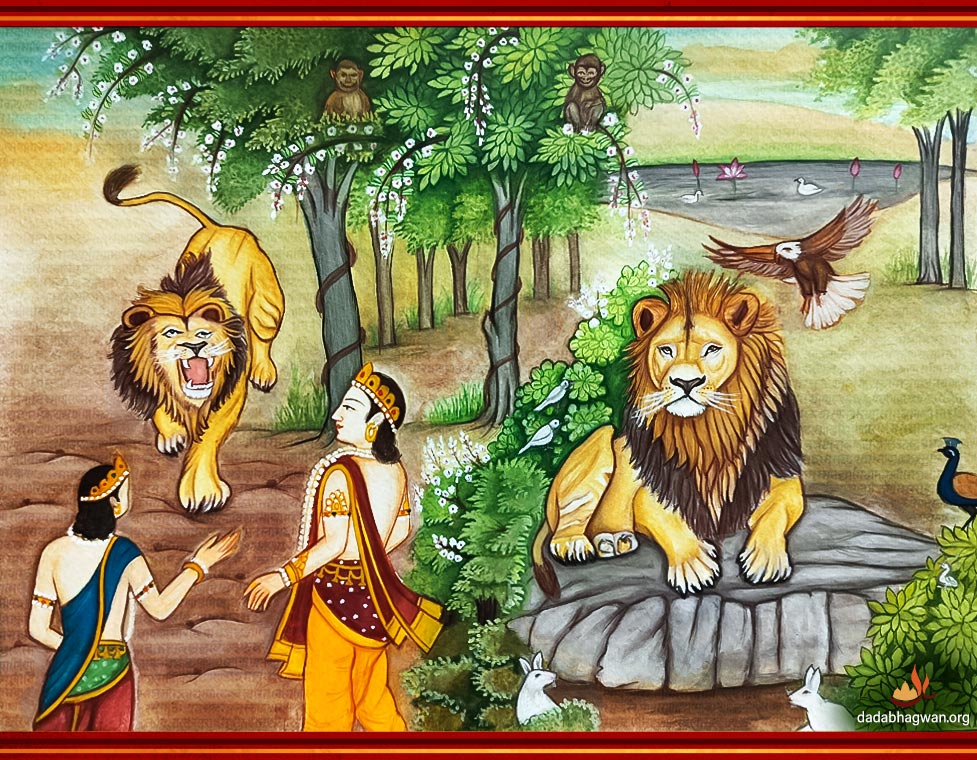
In one of his later births, the soul of Tripushta Vasudev was born as a very fierce lion in a forest. That lion troubled everyone greatly; no one dared to enter that forest. Whoever entered the forest would be killed and eaten by the lion, and therefore, everyone lived in constant fear of it. Once, two celestial beings descended from the heaven to the earth to give sacred teachings to the lion. These celestial beings knew that this was a previous birth of Lord Mahavir, and if the lion did not receive this guidance now, instead of progressing spiritually in the coming births, he would fall even further into lower states of existence. Therefore, the two celestial beings came down in their planes to offer spiritual awakening and guidance to the lion.
When the lion saw the two celestial beings, it roared fiercely in anger and charged toward them. But they were celestial beings, and nothing could harm them. Seeing this, the lion paused and calmed down a little. Taking advantage of this moment, the two celestial beings began to guide and awaken him, speaking to him one after the other: “What are you doing? Do you know who you truly are? In your previous birth, you were Tripushta Vasudev, and before that you were Marichi, the grandson of the first Tirthankara, Lord Rishabhdev. In the future, you are destined to attain the position of a Chakravarti (the emperor of six continents), and ultimately, you will become the twenty-fourth Tirthankar, Lord Mahavir. Why are you stuck in such a state? How much violence you have committed! Awaken… awaken… awaken… Free yourself from these demerit karmas and change your vision. Understand the Real knowledge. The celestial beings can speak and understand all languages, and as the lion listened to these profound words about the Soul and Moksha, a deep calm arose within him. His anger and agitation gradually faded away. He experienced a peace he had never felt before. After this, the lion resolved, “From now on, I will not kill any living being.” Hearing the guidance of the celestial beings, the lion felt deep repentance for his past actions. He remembered all the violence he had committed, how many animals and humans he had killed. As these memories arose, tears began to flow from his eyes. With folded forelegs in devotion, the lion repented sincerely for all his sins. And as these tears of repentance flowed, his heart became purer and lighter with every moment.
Through sincere repentance, even the gravest demerit karma can be cleansed. That is why the Tirthankaras have given powerful weapons such as pratikraman (asking for forgiveness), pratyakhyan (resolving to not repeat that mistake), and alochana (recollection and confession of a mistake) as means to wash away the demerit karmas we commit. A truly aware and awakened person should perform pratikraman at every moment, continuously reflecting upon and correcting one’s actions.
Until true repentance arises, no demerit karma can be washed away; instead, the burden of those sins keeps increasing. After receiving this awakening, the lion washed away his sins with deep tears of repentance, and his heart became very pure. Then, again and again, he bowed in reverence to the two compassionate celestial beings and circumambulated them with deep gratitude. His heart was filled with sincere admiration and devotion toward them. After giving him guidance, the two celestial beings returned to their planes and departed. The lion felt a deep sense of separation and longing after they left. He then firmly resolved, “From now on, I will live a life of complete ahimsa (non-violence). Until now, whatever violence I committed was due to ignorance. But now that I have received the right understanding, I will never harm any living being again.” The lion began to follow such a pure discipline that even many great aacharyas (a religious teacher) find difficult to practice. He took the vow of complete fasting and resolved that he would neither eat nor drink for twenty-four hours, not even allowing a single drop of water to enter his mouth. So that people would not panic on seeing a lion roaming in the forest, the lion lay still on a rock under the heat and cold, without any movement, like a lifeless body. In this way, the lion granted abhaydaan (when one conducts oneself in such a way that does not cause fear in or hurt any living being) to others. To ensure that even the tiniest living beings would not be harmed, the lion did not even turn his body. Thinking it to be a dead body, birds pecked at him with their beaks, trying to eat his flesh, and elephants pulled and tugged at his mane with their trunks. The lion endured all this with equanimity. There was not even a single groan or complaint from within him. In this way, he performed intense austerities. For an entire month, he patiently endured all suffering, gradually exhausting his karmas. Remaining in dharmadhyan (virtuous internal state of being that prevents one from hurting oneself or others), he eventually left his body and was reborn as a human being. To rise from an animal birth to a human birth, the lion had to undergo such immense austerities and endure so many hardships.
Param Pujya Dada Bhagwan often used to say, “Worldly sorrows are a vitamin for the soul and worldly happiness is the vitamin for the body.” Therefore, whenever sorrows come into our life, we should consider it as a dose of vitamins for the soul. Otherwise, when suffering comes, people often begin to tremble and lose courage. But we are not cowards.
“The path of liberation is for the brave; it is not the work of the coward.”
With courage and bravery, we must endure and overcome whatever suffering comes our way. If we become fearful and shaken by suffering, that very suffering returns multiplied many times over.
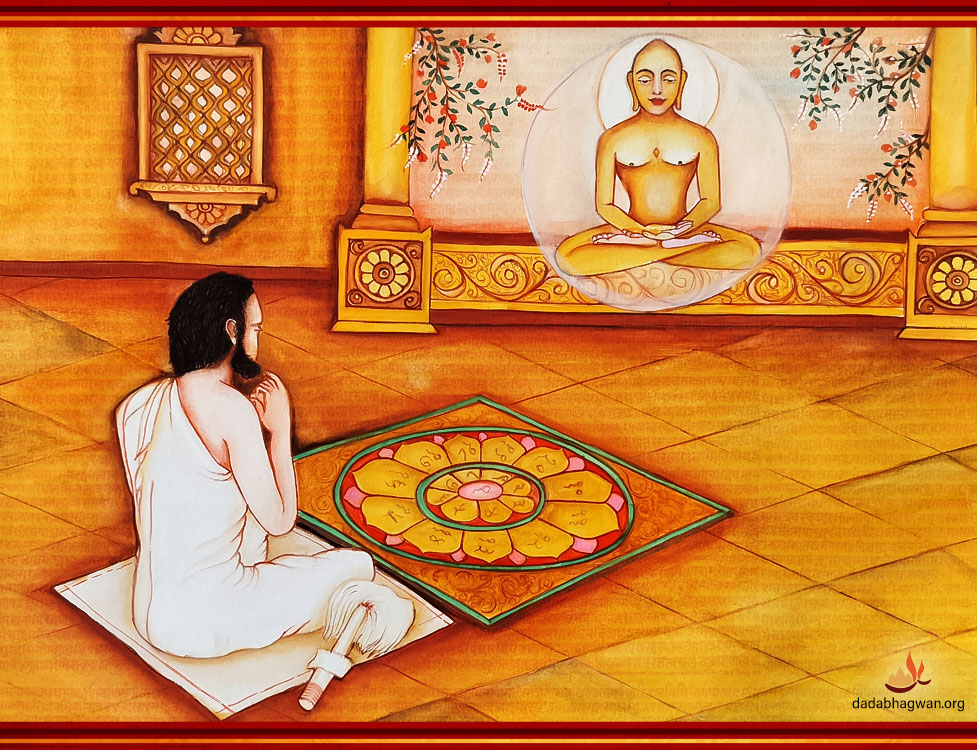
The soul of the lion was born as a human and performed deep devotion and spiritual practices, thereby binding the lifespan of a celestial being. After spending a long period in the celestial realm, the soul was then born in the Apar Mahavideh Kshetra as Priyamitra Chakravarti. As a Chakravarti, he became the emperor of the entire earth and later renounced worldly life and accepted Diksha. Through intense devotion and spiritual practices after taking Diksha, he attained birth in the celestial realm. From that celestial birth, he was later born in Bharat Kshetra as King Nandan. King Nandan also eventually took Diksha and, through deep devotion and spiritual practices, accomplished the Vees Sthanaks, thereby binding the Tirthankara-naam-gotra karma (status-determining karma), the karma that leads to becoming a Tirthankara.
By binding the Tirthankara-naam-gotra karma, he not only secured his own immense spiritual upliftment, but later, as the last Tirthankara of the fourth era, he helped liberate millions of souls and guided countless beings toward Moksha. The position of a Tirthankara is so extraordinary that while attaining one’s own liberation, they simultaneously lead millions of others on the path to liberation. Therefore, we should repeatedly bow to such Tirthankaras, offer our salutations again and again, sing their virtues, and recite their devotional hymns. By doing so, we gain great inner strength, and our Atmavirya (energy of the Self) awakens. After binding the Tirthankara gotra, King Nandan completed the remainder of his lifespan and was then born in the celestial realm.
After enjoying the pleasures of the celestial realm for a very long time, when six months of his celestial lifespan were remaining, the soul that would become Lord Mahavir came to know that the time had arrived for him to descend to earth. Such is the special nature of the celestial realms that when the lifespan of a celestial being is nearing its end, they come to know in advance, through Avadhi Gnan, where their next birth will take place, and at the same time the garland around their neck also begins to wither.
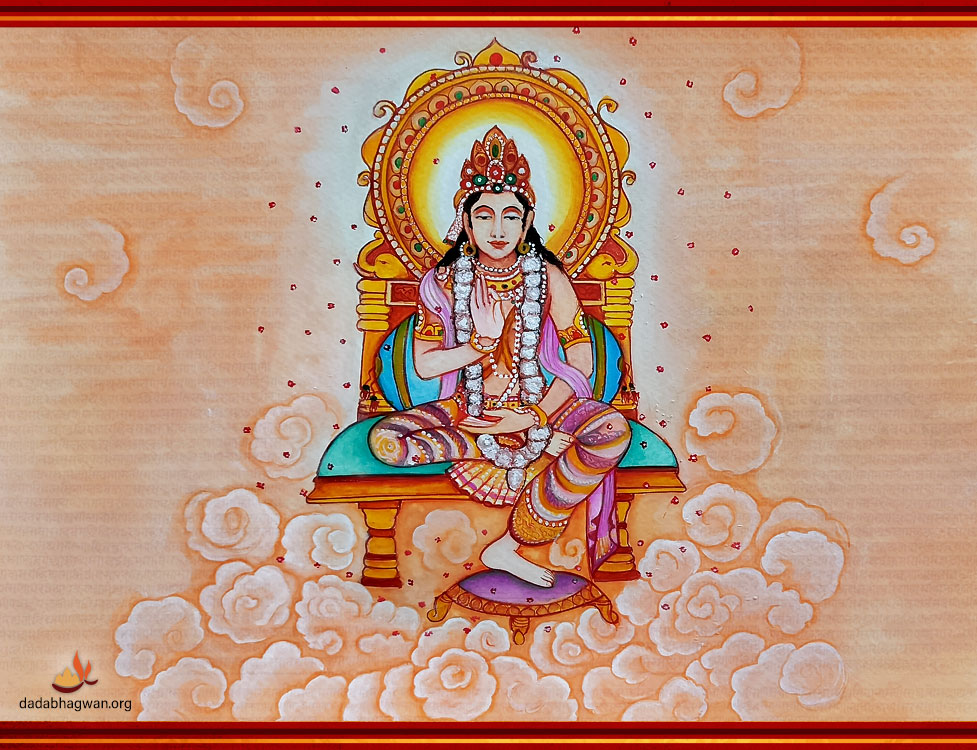
The garlands worn around the necks of celestial beings never wither or dry up. However, when the time of their descent on earth approaches, this becomes a sign that their celestial life is nearing its end. At that time, through Avadhi Gnan, they can also clearly see where their next birth will take place. If they are destined to be born in a higher life-form, their joy increases and if their next birth is going to be in a lower life-form, they begin to feel great sorrow and distress.
Lord Mahavir also received these signs in the same way. However, unlike other celestial beings, He did not feel even the slightest sorrow. Why was that so? Because He was about to receive the body of a Tirthankara! In the entire universe, there is no higher or more exalted embodiment than that of a Tirthankara. Therefore, instead of sorrow, His heart was filled with immense joy and bliss. From the Tirthankara’s body, He was destined to ultimately attain Moksha. Now, let us continue and read about the events from the wondrous chronicle of Lord Mahavir’s garbha-haran (embryo transfer) up to His birth into Diksha.
Related Topic
- Shree Mahavir Bhagwan: Past Lives Part-1 of the Twenty-fourth Tirthankara
- Shree Mahavir Bhagwan: Garbh Haran, Birth, and Diksha of the Twenty-fourth Tirthankara
- Shree Mahavir Bhagwan: Upsargas on the Twenty-fourth Tirthankara
- Shree Mahavir Bhagwan: Sacred Teachings to Chandkaushik Snake
- Shree Mahavir Bhagwan: Incidents with Goshala

subscribe your email for our latest news and events
Dada Bhagwan Foundation, Adalaj is a spiritual non-profit organization whose goal is to spread peace, harmony and everlasting bliss to the whole world through the spiritual science of Akram Vignan.
Ask a question and Get an assured response


