


Shree Mahavir Bhagwan: Sacred Teachings to Chandkaushik Snake
During the time before attaining absolute Knowledge, Lord Mahavir not only gave sacred teachings to the cowherd and Yaksha Dev, but also compassionately guided beings from the Tiryanch Gati (animal realm), such as serpents, and led them to upliftment. The Lord’s sole focus was on the upliftment of others; never once did He think of his own comfort. True benefactors of the world place themselves at risk, yet remain entirely devoted to the liberation of others.
After taking Diksha, Lord Mahavir continued travelling from village to village, and wherever he went, he uplifted and liberated beings. Chandkaushik was a fearsome serpent whose breath was so venomous that anyone who inhaled it would die instantly. This terrifying serpent lived deep within a dense forest.
The Previous Birth of Chandkaushik Snake
Chandkaushik, the serpent, in his previous birth was a great ascetic. The rule is such that even if an ascetic performs intense austerities and accumulates great strength, if there is ignorance present, then at the root of that austerity lies ego. When austerity is done with ego, the ego continues to grow alongside it; and as ego increases, so does anger. Thus, on one side there is austerity, and on the other, anger. That is why it is often said that ascetics can become very quick-tempered. Chandkaushik was such an ascetic, extremely prone to anger. Born in the Kaushik lineage, he was named Kaushik, but due to his intense anger, he came to be known as Chandkaushik. He lived with his Guru and practiced severe austerities.
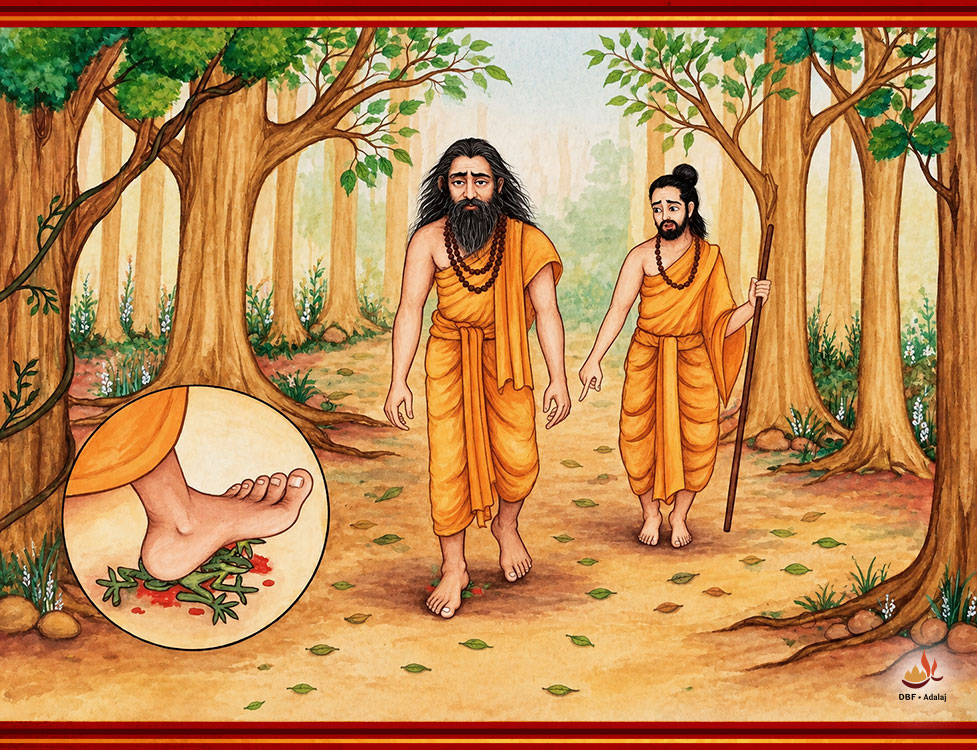
Once, as Chandkaushik the ascetic was returning from the forest after performing intense austerities near the hermitage. At that time, a small frog was accidentally crushed under his feet and it died. One of his fellow ascetics saw this and said, “Oh! It has died! You should do alochana (heart-felt confession of a mistake) and pratikraman (apology coupled with repentance) and free yourself from this sin.” But Chandkaushik paid no attention to it. The rule is that the faults committed throughout the day should be cleansed at night through pratikraman, repentance, and atonement, so that one becomes pure; otherwise, this bundle of sins keeps accumulating with us, growing over time and ultimately spoiling our future births.
One who is progressing on the spiritual path must follow this as a rule. It is a discipline for all seekers that, before sleeping at night, one should confess before the Guru and seek forgiveness. Chandkaushik’s fellow ascetic reminded him, but even then, he did not come into that awareness. Moreover, when Chandkaushik failed to do alochana that night, the next day his fellow ascetic again said, “What are you doing? Why did you not do alochana?”
The intention of the fellow ascetic was good, but instead, Chandkaushik became intensely angry and filled with rage. In that anger, he rushed forward to attack him, but a pillar came in between, and Chandkaushik collided with it. His head was struck and split open; he died. Due to the great austerities he had performed, Chandkaushik was reborn in the celestial realm.
After completing his lifespan in the celestial realm, Chandkaushik was reborn as a human. He became a great ascetic and the head of many ascetics, with numerous disciples in a large hermitage situated deep within a dense forest. The influence of his austerities was immense. However, he had deep attachment and possessiveness toward the forest and everything in his aashram. If anyone casually plucked a flower, broke a branch, picked up a leaf, or even took a rotten fruit, he would become intensely furious and violently beat them, sometimes leaving them half-dead; such was the extreme anger in his nature.
Once, when Chandkaushik had gone out to perform austerities, many princes came to his garden and began playing there, breaking branches, plucking flowers and fruits, and causing a great deal of damage. At that time, one of his disciples informed him, “Many princes have come and destroyed your forest.” Hearing this, Chandkaushik was filled with intense rage. Taking a large axe, he ran to attack them. The princes quickly fled away. Just as Chandkaushik chased them with the axe, he suddenly stepped on a hollow area, lost his balance, and fell into a deep pit. As he fell, the axe slipped from his hand and struck his own head, splitting it open; he died by his own act. Because his death occurred in extreme anger, his next birth was in a lower state, and he was reborn as a terrible serpent. The serpent itself is a symbol of anger. Anger is a very dangerous force.
Liberation of Chandkaushik Serpent by Lord Mahavir
Due to the terrifying flames of anger of Chandkaushik, not even a bird could roam that forest. Such was the fear among people that no human, not even a small bird, dared to go near it; animals and birds would roam elsewhere, but none would enter that forest.
At that time, Lord Mahavir was passing through that region, and the villagers warned Him, “Do not go through this forest; take another route. That serpent Chandkaushik does not spare anyone.” But through His divine Knowledge, Lord Mahavir knew that Chandkaushik was to be uplifted. He did not listen to anyone, for His only focus was the salvation of others, never thinking about Himself. Those who truly work for the salvation of the world are ready to put themselves at risk, even if it means facing death, but their aim remains the upliftment of others. For the sake of liberating even a single serpent, Lord Mahavir did not think of His own safety at all that what would happen to Him!
Lord Mahavir Swami proceeded along that very path. Seeing Him, Chandkaushik the serpent thought, “Who dares to come here?” for he did not recognize the Lord. He approached Him, hissing fiercely and troubling Him greatly, coiling around Him from all sides and tightly binding Him; yet nothing affected the Lord. Lord Mahavir would simply stretch His arms and the serpent would be thrown off. Then the snake became very agitated. In intense anger, Chandkaushik bit the Lord at seven different places on His body. The serpent’s bite was so deadly that even a single one would bring instant death upon anybody, yet it did not have any effect on the Lord; He prevailed in His equanimity. Finally, after accumulating all his poison, the serpent struck the Lord once last time at His foot, but still nothing happened; instead, from within the Lord, a stream of blood flowed; His blood was pure white.
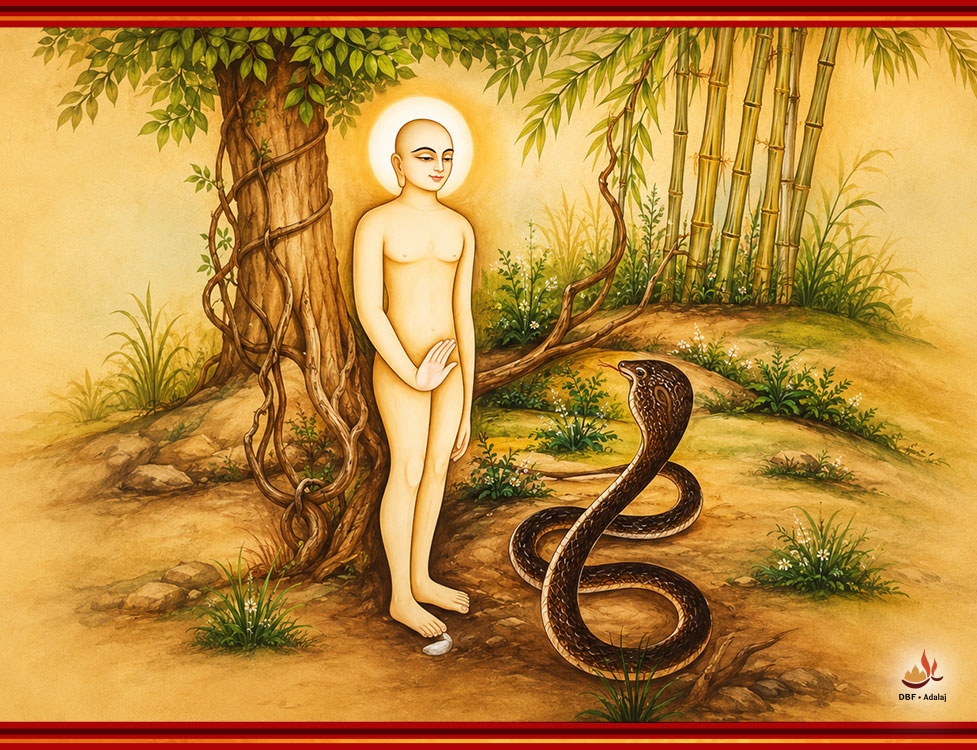
The blood of a Tirthankara is always white. When even a drop of the Lord’s blood entered the mouth of Chandkaushik, the subtle particles of the Lord entered within him, and his entire inner state transformed. Chandkaushik immediately withdrew and thought, “What is this? He is standing as it is; He hasn’t been affected at all! Even such deadly poison has no effect on Him. Who is He?” Then Lord Mahavir spoke, “O Chandkaushik! Awaken, awaken, awaken! What is it that you are doing? Why are you indulging in this? What is the reason for such intense anger? What will you gain from so much anger? You have killed so many animals! You have killed so many travellers! Helpless people who had lost their way, instead of guiding them, you took their lives! What did you gain from this? You were not even going to eat them to satisfy your hunger, yet you killed them without any reason. Only to feed your ego! Do you know what the consequences of all of this will be? Do you understand that the state you are in today is the result of your actions from your past lives?”
When the Lord awakened Chandkaushik in this way, he immediately attained Jatismaran Gnan (Knowledge with the help of which one can recall previous births).! He saw all his previous births and realized, “Oh! I had acted in such anger, fell into a pit and died, and the result of that anger has come to me in this life.” Instantly, deep repentance arose within him, and he fell at the Lord Mahavir’s feet. The Lord’s words penetrated instantly within; he became completely calm. The Lord said, “This body that we have received is meant to realize the Self and attain Moksha. Not to indulge in anger, trouble others, hurt them, and nourish ego, thereby spoiling future lives. Infinite lives have already been wasted; how many more will you waste?”
What Lord Mahavir said to Chandkaushik applies to all beings in the world. Anger, pride, deceit, and greed keep us wandering through endless lifetimes. Hearing this, Chandkaushik underwent a complete transformation of heart; he immediately became peaceful and turned back. After uplifting him, the Lord moved ahead on His path.
After this, Chandkaushik resolved that he would not cause even the slightest harm to any living being and remaining without food or water, he began repenting deeply for his past sins. He coiled himself in one place, lying there like a lifeless body. Meanwhile, people were also amazed; Mahavir Swami remained completely unharmed and nothing happened to Him. They had climbed the trees to witness this entire incident and then they climbed back down, one by one went near Chandkaushik and began poking him with sticks to check what has happened to him. Is this Chandkaushik alive or dead? At that time Chandkaushik deliberately lay still like a corpse. What hardships he faced, he endured them with perfect equanimity, determined to settle all his karmic account.
People beat him so severely that his spine was broken; he appeared completely lifeless. Still, he had tucked his head into a burrow so that no one would feel fear on seeing him. He must’ve had such inner equanimity and deep repentance for all his paap (demerit karma). Believing him to be dead, the women that were passing by there were carrying some ghee with them; they applied some of that ghee over his body with reverence and left. Attracted by the smell of that ghee, large red ants gathered there and began eating his body, making it porous like a sieve. Even though the ants bit him repeatedly, Chandkaushik endured everything in complete equanimity. He did not even move slightly, lest any of the ants be crushed and killed.
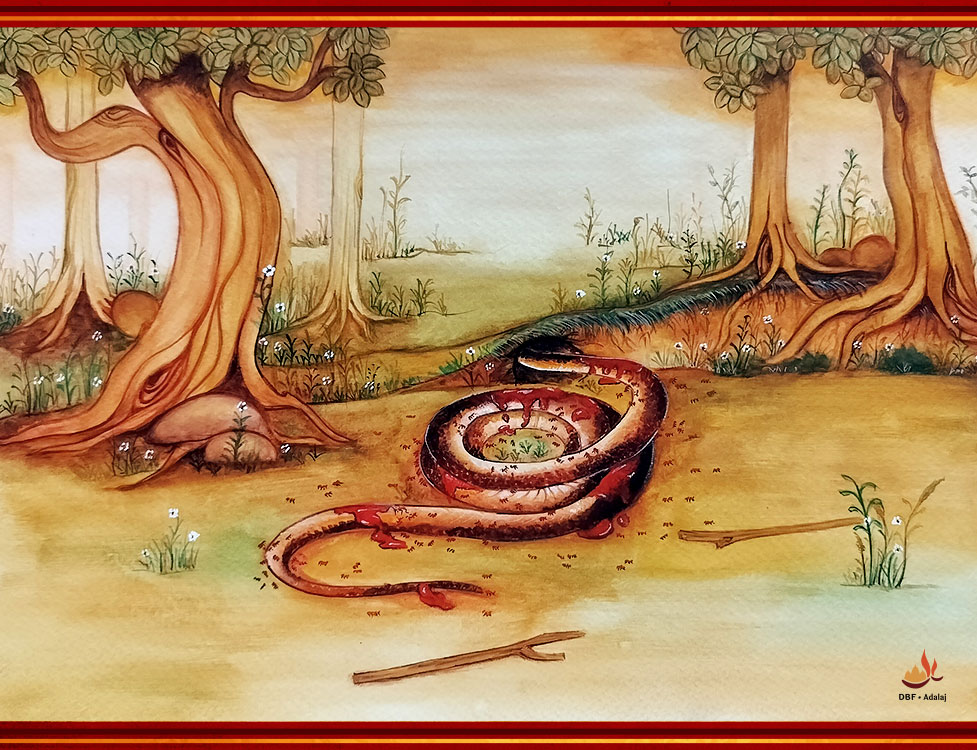
With such grave alertness and effort, he exhausted his karmas. In this way, remaining in dharmadhyan (virtuous internal state of being that prevents one from hurting oneself or others), contemplating upon the Lord and reflecting deeply on His teachings, he completed his lifespan. After a week, he left his body, but since his final inner state had completely transformed, he was reborn in the celestial realm. By washing away his sins, in just eight days he bound immense punya (merit karma). Such is the power of repentance, atonement and pratikraman that the one who was heading toward the hell ife-form, within a week purified himself and attained the celestial life-form.
In the same way, whatever faults or sins we may have committed in our lives, whatever suffering we may have caused to others, we too can cleanse them through sincere repentance and pratikraman, and completely change our future course. Such is the immense power of repentance, atonement and pratikraman. From the story of Chandkaushik, we must awaken to this understanding; realize the consequences of anger and strive to come out of it. By repeatedly practicing repentance and pratikraman, one can gradually free oneself from anger.
Nagkumar Deva's Upasarga on Shree Mahavir Swami
After taking Diksha (renunciation), while wandering, once Shree Mahavir Swami came to the banks of the Ganga river. He wished to cross to the other side and had to take the support of a boat. The Lord approached a boatman and sat in the boat along with other people. At that time, a Nagkumar Deva was passing using the route of the sky and saw the Lord. There was a karmic account of vengeance between Nagdeva and the Lord from a previous birth. When the Lord, in His earlier birth as Tripushta Vasudev, had killed the Kesari lion; upon seeing the Lord, that old enmity flared up within the Deva.
To settle that enmity, the Nagkumar Deva made terrible afflictions. He stirred a violent storm in the river; shook the boat in which Lord Mahavir Swami was seated, and caused the waters to rise and crash down. The people in the boat were terrified and felt that they would surely die, but how can a boat in which the Lord Himself was seated, sink; such a boat is destined to reach the shore safely!
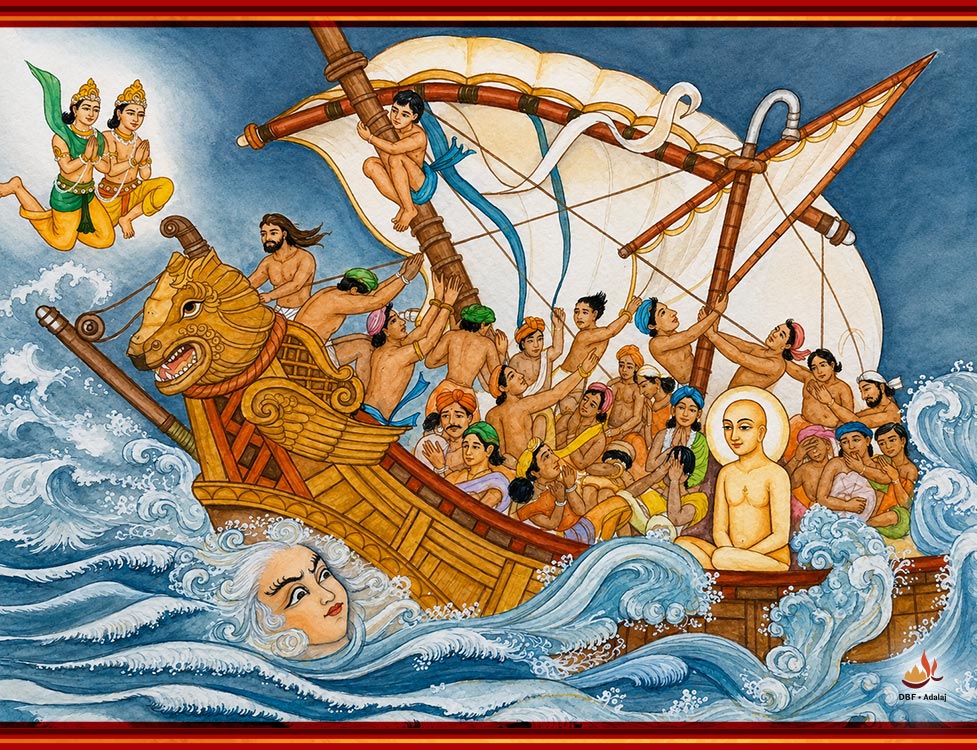
By merely taking Lord Mahavir’s name or doing His darshan, beings who have been wandering endlessly through lifetimes can find the shore of Moksha, then what is it for the Lord to cross the Ganga river! Such was the immense yashnaam karma (credit bearing name-form karma) of the Lord that even those seated in the same boat were undoubtedly protected! Moreover, the Lord was charam shariri (the One having a final body before attaining ultimate liberation), so He couldn’t be killed before his time. While everyone else in the boat was shaken by the turbulence, the Lord remained perfectly steady, not even a single particle of His being moved, and there was not the slightest change in the expression of His face.
While this fierce storm was raging, two other Nagkumar Devas were passing through the sky route. Seeing that the first Nagkumar Deva was troubling the Lord so intensely and causing such hardship to Veer Prabhu, they immediately intervened. They lifted the entire boat and safely placed it on the riverbank. Then a great battle took place between them and the hostile Nagkumar Deva (who in a previous birth had been the lion).
That hostile Deva had already become weak, while the other two Nagkumar Devas were youthful and powerful, and together they defeated him. After this, Indra Dev arrived and showered flowers, and all the Devas, including the Nagkumar Devas, bowed at the Lord’s feet. The people who had been in the boat also realized, “Oh! This is Veer Bhagwan!” and by doing His darshan, they too attained spiritual upliftment.
Importance of the Living Bhagwan
As Lord Mahavir moved ahead, crossing the river and walking over the sand, His footprints were left behind in the sand. The Lord continued His journey, progressing forward to exhaust His karmas. At that time, a highly skilled expert in the science of bodily signs saw those footprints and immediately recognized that these were not the footprints of an ordinary person; the markings appeared somewhat to be those of a Chakravarti.
He thought, “If I follow these footprints and find Him, and bow at His feet with devotion, I too may gain some material benefit.” With such worldly intent, he followed the trail, wandering deep into the forest, until finally he saw Lord Mahavir seated in meditation, in a Digambar state. Seeing the Lord in that state, he felt disappointed within and thought, “This almsman! What can He possibly give me?” Filled with disappointment and inner restlessness, he prepared to turn back.
At that moment, through Avadhi Gnan, Indra Dev came to know, “This poor man has wandered through so many forests to have Lord Mahavir’s darshan! Even though he has material desires, he has still come for the Lord’s darshan, he must receive some benefit.” Lord Mahavir Himself had no concern for such matters; He remained completely absolutely detached, absorbed in His own awareness of the pure Soul. But Indra Dev felt deeply that the Lord’s darshan should not go in vain.
So, Indra Dev personally appeared and granted the man heaps of wealth. The man became overjoyed, bowed at Lord Mahaveer Swami’s feet, and prepared to leave. In truth, he had not even recognized the Lord, he had thought Him to be just a almsman, but Indra Dev revealed to him that this was a Tirthankara Lord. Realizing this, the man felt delighted and left with great happiness, taking the wealth with him.
In this way, even without truly understanding or recognizing the Lord, just doing His darshan brought such immense benefit! Whose darshan was it? Of a Tirthankar Lord! A Vitaraag Purush!! Who desires nothing of this world. To whom, not even a single particle can attract. To do the darshan of such a detached and enlightened Lord is something extraordinary; naturally, one who attains the living darshan of the Lord in that time is truly most fortunate.
Even though the twenty-four Tirthankaras of this era have attained Moksha, there are still living Tirthankara Lords present in the universe. At present, twenty Tirthankaras exist in this universe. Though not in our Bharat Kshetra, but they are present in the Mahavideh Kshetra. According to Jain geography, there are fifteen such Kshetras - five Bharat Kshetras, five Mahavideh Kshetras, and five Airavat Kshetras, where Tirthankaras, Gnanis (the awakened Ones), and humans like us all exist.
At present, there are no living Tirthankaras in the Airavat or Bharat Kshetras, but in the five Mahavideh Kshetras, twenty Tirthankaras are currently present. Among them, Lord Simandhar Swami is very close to us and is karmically connected to us. By specifically doing His darshan, we can attain extraordinary benefit, the benefit that can take us ahead on the path of Moksha. Wherever one gets the opportunity to do darshan of such a Vitaraag Lord, one should certainly strive to reach there, for it brings immense benefit and purifies the inner consciousness completely.
Let’s read further about how Lord Mahavir came across Goshala, the various incidents surrounding them, and how the Lord remained in equanimity throughout.
Related Topic
- Shree Mahavir Bhagwan: Past Lives Part-1 of the Twenty-fourth Tirthankara
- Shree Mahavir Bhagwan: Past Lives Part-2 of the Twenty-fourth Tirthankara
- Shree Mahavir Bhagwan: Garbh Haran, Birth, and Diksha of the Twenty-fourth Tirthankara
- Shree Mahavir Bhagwan: Upsargas on the Twenty-fourth Tirthankara
- Shree Mahavir Bhagwan: Incidents with Goshala

subscribe your email for our latest news and events
Dada Bhagwan Foundation, Adalaj is a spiritual non-profit organization whose goal is to spread peace, harmony and everlasting bliss to the whole world through the spiritual science of Akram Vignan.
Ask a question and Get an assured response


