


What did Arjun see in the virat swaroop of Krishna?
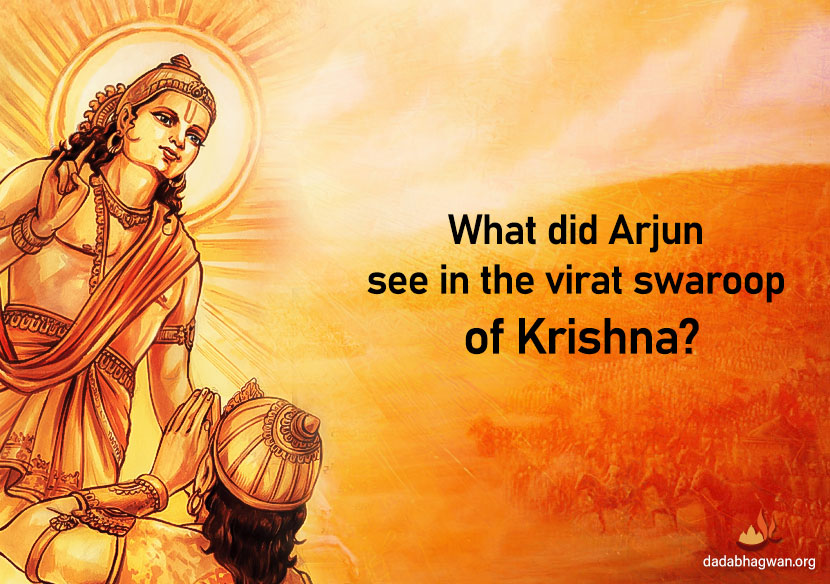
In the eleventh chapter of the Bhagavad Gita, Arjun requests Lord Shri Krishna, “O Yogeshwar! If You think I am capable of seeing it, then kindly grace me with the vision of Your imperishable (eternal) form!” And at that time, Lord Shri Krishna granted Arjun, the vision of the vast cosmic form, the darshan of virat swaroop of Krishna. What is this virat Darshan? What was seen in it? With what kind of vision did Arjun behold the Cosmic Form? What change did it bring about within him? Revealing all of this, Param Pujya Dada Bhagwan says that, “vishwadarshan is not the same as Atmagnan (knowledge of the Self). So many are born, die and are born again. This is how everyone is caught up in the time cycle, therefore, there is no one that kills or gives or spares life (creator, sustainer, destroyer). “Therefore, Dear Arjun, the moha (the illusion) that attaches you to doership, that you are ‘doing’ the killing, is wrong; so, let it go.” For this Lord Krishna showed him a violent and a very frightful scene; he showed Arjun a vast picture wherein everyone is dead. Upon beholding this, Arjun was shaken up, but as he understood everything, he became ready to fight. Then, the Lord showed Arjun the tranquil state of the Self.”
Lord Shri Krishna tells Arjun, “You will not be able to see My True form with your physical eyes. Therefore, I grant you divine Vision. With that, behold My magnificent Godly qualities.”
That divine vision itself is what is Sudarshan. We usually recognize Shri Krishna’s Sudarshan Chakra as a weapon that rotated rapidly on His finger and could sever the heads of enemies, this is what we commonly understand. But Lord Shri Krishna’s Sudarshan was not a physical chakra. Sudarshan means su + darshan. Shri Krishna had attained samyak Darshan (right Vision of 'I am pure Soul') from Tirthankara Lord Neminath, and that is what was called Sudarshan.
When Shri Krishna was delivering the teachings of the Bhagavad Gita to Arjun, He granted him the divine vision for a short time. With that divine sight, Arjun perceived “atmavat sarvabhuteṣhu”, meaning he saw all living beings in the form of pure Soul.
Shri Krishna Bhagwan has said that, “A Gnani Purush (One who has realized the Self and is able to do the same for others) burns away the sins of countless lifetimes. Not only does He burn away those sins, but He also grants divine vision and establishes the awareness of one’s true Self.”
Before seeing the virat swaroop of Krishna, Arjun became frightened. But upon witnessing it, Arjun surrendered all his ego completely at the feet of Lord Shri Krishna. Param Pujya Dada Bhagwan says that, “The One who takes away the ego of others is referred to as a viraat Purush.”
He explains to us here what the virat Darshan truly is.
Dadashri: The darshan of the viraat form means recognizing the Gnani Purush. In the true sense, who can be referred to as viraat? The One who devours your ego as well. The One who can destroy even your ego is known as the viraat One! And what is the result of that? It makes You viraat. Without [attaining] the viraat swaroop, no one would bow down to Him! It was only when Lord Krishna showed Arjuna such a viraat swaroop that Arjuna bowed down to Him [in surrender]; otherwise, he would not have bowed down.
This ego is such a thing that it will not leave even after a hundred thousand lifetimes. A person told ‘us’, “You have certainly taken my ego away!” So, He [the Gnani Purush] is a viraat Purush! Instead, are you looking for a viraat Purush as per the scriptures? The One who takes away our ego is a viraat Purush. Otherwise, what other kind of viraat Purush would there be in the world?
What can be referred to as virat swaroop? The ‘One’ in whom there is not even the slightest intellect, not even a drop of intellect. By continuously prodding at it like this, He gets rid of the ego completely, just like removing all the air out of a tire. Therefore, the One whose ego has completely gone is the only One who can take it. The One whose own ego has completely exhausted is an Atma Gnani (One with the complete Knowledge of the Self). The One who takes away the ego of others is a viraat Purush!
In the middle of Kurukshetra, Lord Shri Krishna gave the extraordinary teachings of the Gita to the disheartened Arjun, who had said, “I will not fight against my own relatives,” and in the end granted him the virat Darshan. In this vision, Arjun saw the true nature of the world, its destructible nature. As a result, Arjun’s ego of doership completely melted away, and he surrendered fully at the refuge of the Lord.
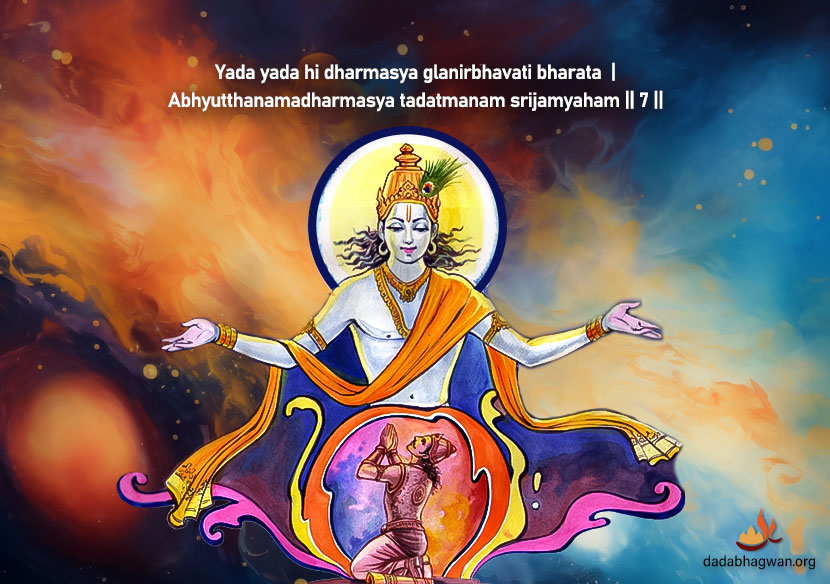
Shri Krishna Bhagwan also says in the fourth chapter that such virat Gnanis continue to take birth again and again.
Yada yada hi dharmasya glanirbhavati bharata |
Abhyutthanamadharmasya tadatmanam srijamyaham || 7 ||
Paritranaya sadhuna vinashay cha dushkritam |
Dharmasamsthapanarthaya sambhavami yuge yuge || 8 ||
Meaning, “O Arjun! Whenever there is a decline of righteousness and a rise of unrighteousness, at that time I manifest Myself on this earth. To protect the virtuous, to destroy the wicked, and to re-establish dharma, I take birth age after age.”
It does not mean that Lord Shri Krishna Himself takes birth again and again. Just as one prime minister finishes his term and another prime minister comes, and whoever holds the position of a prime minister helps the nation, in the same way, a Soul who has attained the state that Shri Krishna had, takes birth again and again. The Soul of Lord Shri Krishna has manifested, and such a manifested Soul takes birth again in another body. Gnani Purushs and Tirthankara Lords continue to take birth, showing people the path to happiness, peace, freedom from all suffering, and ultimately liberation. After uplifting countless beings, they themselves attain liberation as well.

subscribe your email for our latest news and events
Dada Bhagwan Foundation, Adalaj is a spiritual non-profit organization whose goal is to spread peace, harmony and everlasting bliss to the whole world through the spiritual science of Akram Vignan.
Ask a question and Get an assured response


