


Are superstitious beliefs of good omens and bad omens true?
The superstitious beliefs of good omens and bad omens are believed to be prior signs indicating whether the outcome of an activity will be auspicious or inauspicious. Across the world, many such beliefs are prevalent. Some people believe that a cat crossing one’s path, sneezing, milk boiling over, twitching of the eye, washing hair on certain days, or sweeping the house in the evening are signs of bad omens. In some situations, breaking glass is considered a good omen, while in other situations it is regarded as a bad omen. Often, certain colours and numbers are also associated with bad luck and good luck. Because of this, different superstitious beliefs prevail in different countries, something considered auspicious in one place may be considered inauspicious in another.
By blindly imitating worldly beliefs about good omens and bad omens without understanding or reflection, we end up wasting our time and energy. In reality, we are to manifest inner strengths within the human body. Instead, by getting caught up in good omens and bad omens, a person shifts the responsibility for success or failure in life onto external factors and seeks false reassurances. This weakens one’s inner strength. When false beliefs take root in the mind, one ends up becoming quite unhappy. The principle is simple, if there is no superstition or delusion in our mind, then no omen or ill-omen can trouble us.
Inauspicious numbers
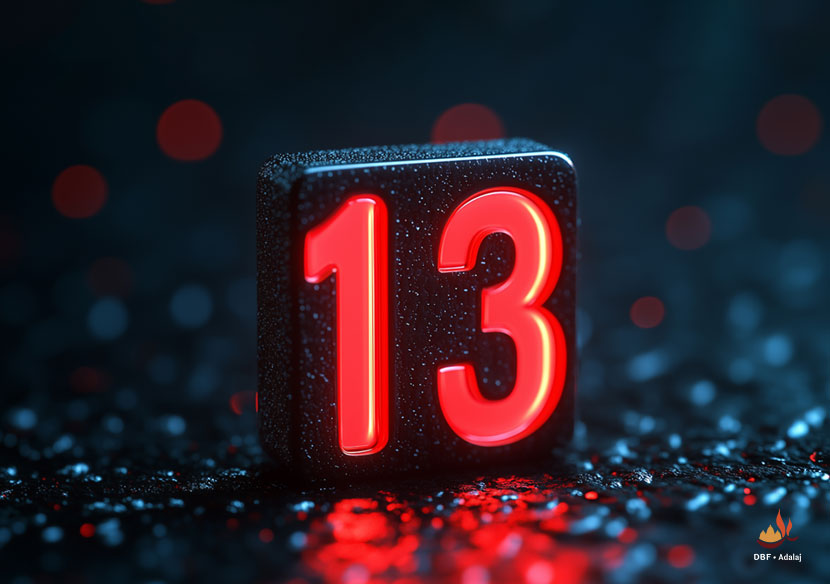
In Western countries, the number thirteen is considered inauspicious. As a result, in many high-rise buildings there is no thirteenth floor; after the twelfth floor, it goes directly to the fourteenth. Similarly, no room is given the number thirteen, because no one is willing to stay in a room with that number. Now, if the number thirteen is inauspicious, what should a person born on the thirteenth do? Will no one marry such a person? Will that person never succeed in life? In some countries, the number nine is considered auspicious, while in some other countries the same number nine is considered inauspicious. So it can be inferred that all these are merely superstitious beliefs. Success or failure has no connection with numbers.
‘Lucky’ objects or people
At a personal level, we often believe that a particular dress is lucky, because when we wore that dress, some important task happened to succeed by coincidence. Then, for every important task thereafter, we keep wearing the same dress again and again. If an important person visits our home, we say that Lakshmi has entered the house because of them. But if that same person enters the house where they live every day then why does it not bring them special benefit there? This itself shows that it is merely a belief. We may believe that if our eye twitches today, something unpleasant is bound to happen. If we step out of the house with the left foot first, we feel that the whole day is going to go wrong and we keep worrying about it. But if we recall the past, such things must have happened countless times. Among those occasions, at least once our belief must have proved wrong. Just because once a crow sat on a branch and the branch broke, it does not mean that every time that a crow sits on a branch, it will break. In the same way, there is no need to believe that every time such a sign occurs, it will surely result in a bad omen. All this is nothing but superstitious beliefs.
Circumstances changed after someone’s arrival
Some people believe that after the birth of a son or daughter, the situation in the household improved. Or that after the birth of a son or daughter, the household situation began to deteriorate. If, after marriage, a daughter-in-law enters the home and someone passes away, then the daughter-in-law ends up being blamed for the rest of her life. In reality, it is only one’s own karma that gives results. When paap(demerit karma) comes into effect, adverse circumstances arise, and when punya (merit karma) comes into effect, favourable circumstances arise. The effects come only from one’s own causes; time, place, circumstances, and people merely become instrumental factors. What fault do other people have in it? Therefore, placing blame on any person is a form of false belief or superstition. No person can harm us or give us suffering. In this world, it is only wrong understanding that causes suffering. No object, person, living being, or circumstance can give suffering. If our understanding is inverted, there is only suffering, suffering, and suffering. When that same understanding becomes right, then for us, suffering will no longer exist in the world. Therefore, we should not allow the inverted superstitious beliefs to enter our mind; otherwise, they will certainly trouble us.
A cat crossing one’s path
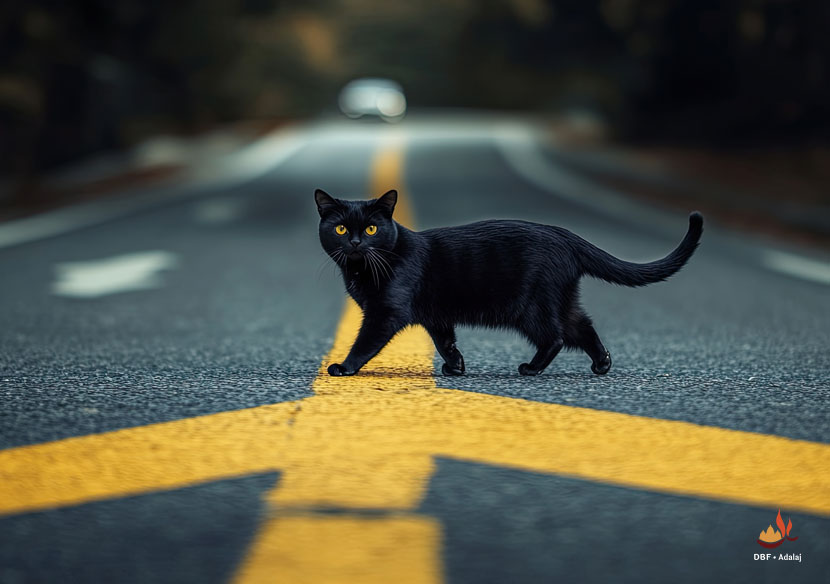
In India, if a cat or a donkey crosses one’s path, it is considered a bad omen. Whereas in some other countries, if a black cat crosses the road, it is considered an omen of good fortune. So what is the truth in all this? We say, “Today a cat crossed my path, and that is why a loss occurred.” But what may have actually happened is that while walking and watching the cat, a doubt arises that something bad will happen. Because of that doubt, one becomes careless, misses a step, and falls. Then one says, “It happened because I saw the cat!” Now the cat crosses that road every day, but because we noticed it and allowed doubt to arise, the trouble followed, otherwise nothing would have happened. Once the doubt arises that “the cat will cause harm,” that belief starts working, and the person remains unhappy the entire day. In reality, the cat does not cause harm; our doubt causes harm. Whatever is destined to happen according to our karmas will happen, how can merely seeing a cat bring about any change in that? Therefore, beliefs that make us unhappy should be set aside. For the one who believes, it becomes an ill-omen; for the one who does not believe, nothing happens. In reality, every living being, whether a cat, a donkey, or an owl has a Soul within. If we look at every living being with the understanding that God resides within each one, that the Parmatma is present within all, then how can there be any ill-omen? With such a vision, no bad omen remains, and one can come out of these superstitious beliefs.
Auspicious and Inauspicious timings
In India, before undertaking any auspicious activity, people consult the traditional Vedic astrological time-tracking system to determine an auspicious timing, so that the work may be completed smoothly and successfully. However, many times, even work that is begun after selecting an auspicious timing, it does not get completed. If this practice were truly scientific, then its principle should never change. What is a principle? When two atoms of hydrogen and one atom of oxygen combine, only water is bound to be formed. In any field, at any time, and under any circumstances, that principle remains absolute and unchanging. But if a principle changes, then it should be understood that there is a contradiction in it, and that it is not scientific. If, after consulting the traditional astrological time-tracking system, sometimes there is benefit and sometimes loss, then it should be understood that there is no principle in it. Gain or loss comes to me based on my own good and bad karmas. In reality, the moment at which we begin any work after praying to the Lord or celestial deities in whom we have faith, that is the most auspicious timing of all. It is also said that during the monsoon season the Gods go to sleep, and therefore there is no auspicious timing for marriage. But in reality, if one tries to conduct weddings during the monsoon, it becomes impractical to take out a wedding procession in the rain, burst firecrackers, or step out wearing expensive clothes. India is an agriculture-based country, and earlier farmers were busy with farming during the monsoon, so there was no time for weddings. Therefore, behind fixing certain auspicious timings, the intention may have been to maintain social order. On the other hand, if we look at it differently, religious discourses and spiritual gatherings continue vigorously during the monsoon season, then doesn’t the “principle” of auspicious timings obstruct those? Hence, we should not get caught up in such superstitious beliefs. We should accept that whatever work we do, at the time we do it, is appropriate.
Vastu Shastra
According to ancient systems such as Vastu Shastra and Feng Shui, practices have long existed regarding the design of residences, the arrangement of furniture, and the placement of certain objects within the home. In these systems, keeping the main door, bed, and other elements oriented in specific directions is considered auspicious. It is believed that this increases happiness, peace, and prosperity in the household. Many people, with the intention of resolving financial, physical, or family difficulties, even go to the extent of breaking and reconstructing parts of their homes, offices, or factories to change the direction of construction.

In reality, when we look around, many people construct their homes according to the rules of Vastu Shastra and spend lakhs and even crores of rupees on it, yet they do not attain lasting success. Many times, when people go to Vastu consultants, they are told, “The door of the house you live in faces the south; therefore, Lakshmi (money) is leaving your home.” Even a person who has lived in that house for twenty years gets influenced by such statements and ends up breaking and reconstructing parts of the house to change the direction of the door. By blaming the door for one’s failure, a sense of reassurance is obtained. Yet, the loss does not really get resolved; on top of that, the expense of changing the door is added. Even if a change does occur, it is still dependent on circumstances. This is because a period of loss lasts only for a certain time, and once that period ends, profit is bound to come anyway. But the person comes to believe that the profit occurred because the door was changed. In this way, superstition takes root. Once the belief settles in that “this door is in the wrong direction” or “this cupboard is placed incorrectly,” the person continues to remain unhappy, believing that the situation has deteriorated because of that. If happiness and prosperity truly came from Vastu Shastra or Feng Shui, then the lives of all Vastu consultants should be completely free from suffering. But that is not what is observed.
If an action performed based on the religious scriptures sometimes succeeds and sometimes does not, then it should be understood that it is not the truth. For example, when we heat water, it turns into steam, and when steam cools, it becomes water again, that is a principle. In the same way, if there were a scientific principle behind Vastu Shastra or Feng Shui, then it should yield results for everyone. But if that does not happen, then it is not science; it is merely a belief. Happiness and suffering arise based on a person’s punya (merit karma) and paap (demerit karma); objects or houses do not cause them. The rise and fall of merit and demerit karma continue in cycles. Changing the position of an object or the direction of a door cannot bring about any change in one’s karmas. In fact, it is written on the very first page of Vastu Shastra that for those who abide in one’s true Self (the Soul), for them there is no need for Vastu Shastra at all.

subscribe your email for our latest news and events
Dada Bhagwan Foundation, Adalaj is a spiritual non-profit organization whose goal is to spread peace, harmony and everlasting bliss to the whole world through the spiritual science of Akram Vignan.
Ask a question and Get an assured response


