


What does the Bhagavad Gita say about the trigunatmak nature or trigunas (3 Gunas) of Prakriti?
Traigunyavishaya veda nistraigunyo bhavarjun |
Nirdvandvo nityasattvastho niryogakshem atmavan || 45 ||
In this verse from the second chapter, Lord Shri Krishna tells Arjun that the Vedas describe the three qualities or trigunas of prakruti (the relative self with inherent characteristic traits). O Arjun, you must rise above these three qualities. Stay firmly established in the Self, which is free from all dualities (dwandva), remain steady in pure sattva (the attribute of being virtuous), go beyond yogkshem (activities necessary for making a livelihood).
Param Pujya Dada Bhagwan says, “‘Traigunya vishayo vedo nistraiyai gunyo Bhavarjuna’, this is an extraordinary statement that Lord Shri Krishna has said in the Bhagavad Gita.” Before meeting Tirthankar Lord Neminath, Lord Krishna Himself was a student of the Vedanta. After extracting the essence of the Vedas and showing the path ahead, He told Arjun, “The Vedas are associated with these three qualities (trigunas), so only when you rise beyond them will your work be accomplished. These three qualities are themselves a form of duality. Therefore, go beyond the trigunatmak state and understand the Self!”
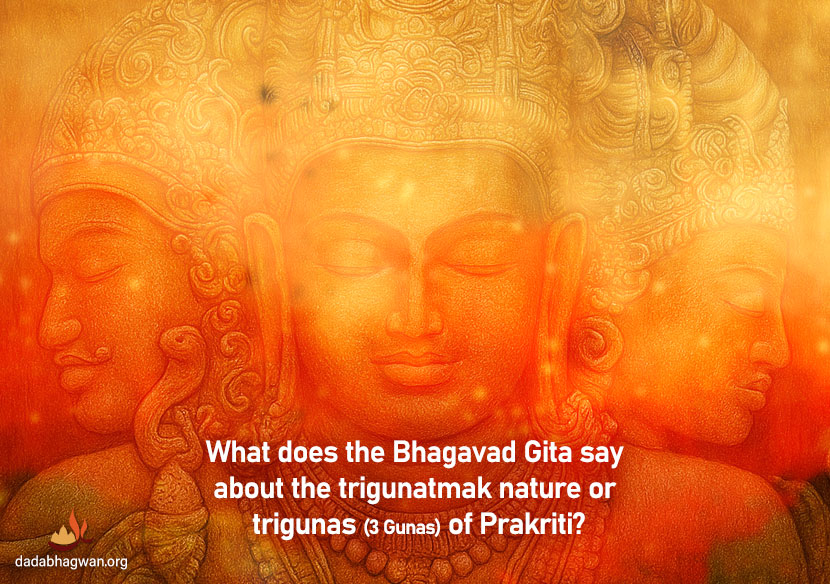
Shri Krishna explained to Arjun that the Vedas illuminate only the three qualities - sattva, rajas, and tamas (the three physiological qualities of the physical body). As symbolic representations of these trigunas, three presiding deities have been placed: Brahma, Vishnu, and Mahesh. These are not actual persons but symbolic representations of the three qualities, placed so that devotees who cannot grasp the subtle meaning of the gunas may worship these symbolic forms instead. The qualities of the ones we worship arise within us. Thus, the ones with tamoguna worship Mahadev, ones with sattvaguna worship Brahma, and ones with rajoguna worship Vishnu.
Lord Shri Krishna has also described the characteristics of these three qualities.
Sattvam sukhe sanjayati, rajah karmani bharat |
Gnanamaavrutya tu tamah, pramade sanjayatyut. || 14.9 ||
O Bharat! Sattva guna binds one through happiness. Rajo guna binds one through constant activity and action. But Tamo guna covers up knowledge and truly binds one in negligence, carelessness, and delusion.
Param Pujya Dada Bhagwan goes on to describe the characteristics of people who are influenced by these trigunas of nature.
Dadashri : What is called Sattvaguna? Those saints and seekers who have turned towards God, all of them are in Sattvaguna. And who is called Rajoguni? A Rajoguni person is someone who cannot sit still even for ten minutes in an entire day; if you try to make them sit, they feel as if a scorpion is stinging them. They keep working the whole day without stopping. Have you seen such Rajogunis? They work nonstop the entire day, if they have to sit for even two hours in an entire day, they simply cannot sit still and do so. All such people are called Rajoguni. And those who remain absorbed in sensual pleasures the whole day and do not do any work, all of them are called Tamoguni.
People who possess Sattvaguna are pure, peaceful, harmless, and naturally inclined to help others. Rajoguna creates attachment to action, a strong drive for doing work. Such people themselves cannot sit idle, and they do not let others sit idle either. Tamas means darkness. Just as darkness covers light, when tamoguna increases it brings a veil over knowledge. People with a predominance of tamasic qualities tend to have an angry nature.
Ultimately, even the Vedas also say that, “Become free from these trigunas and become a true Purush (the Self).” Because, in reality, the Self is separate from all these gunas. It is prakruti (the non-Self complex) that acts, but out of ignorance a person believes, “I did it,” and that very belief creates bondage.
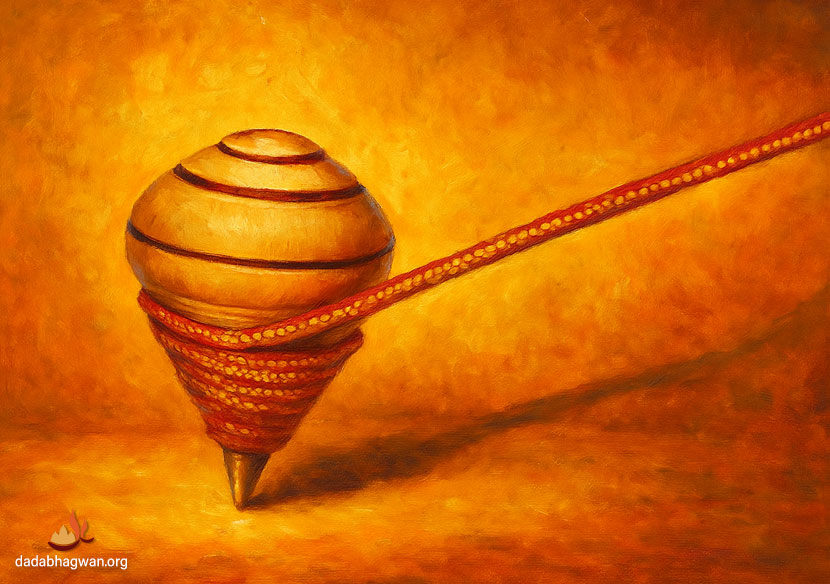
Just as a spinning top unwinds because the string was wound around it, the top itself has no personal effort in the process; in the same way, it is prakruti that makes everything dance but a person believes, “I danced!” What personal effort is there in that? If someone earns lakhs of rupees, they claim, “I earned it,” and when they suffer a loss, they say, “God gave me the loss!” In this way, because of the lack of true understanding, people live their lives caught in such contradictions.
Param Pujya Dadashri, in very simple language and with gentle humour, beautifully explains here how one gets mixed up in the natural qualities of prakruti.
Dadashri: It is prakruti that dictates what you do, but you claim to be the doer. Fasting, doing penance, meditating, giving alms, being kind, speaking the truth, practicing ahimsa (non-violence) are all attributes of the prakruti. Good habits or bad habits are all qualities of the prakruti. However charming and graceful one’s prakruti may be, one never knows when it will deceive him or disgrace him. You may have a king who is very benevolent and devout but if he were to get lost in the jungle and not eat for days, would he be embarrassed to beg for food? Definitely not! What happens to his imperial and monarchical qualities at that time? Alas! His prakruti is crying out from within and he is trapped in circumstances that reduce even a king to becoming a beggar. If this can happen to a king then what chance does a commoner have? It is the prakruti that makes you give alms and it is the prakruti that makes you beg, so where is your effort in that? A thief steals twenty rupees, goes to a restaurant and orders a nice meal and enjoys himself. On his way out he gives the remaining ten rupees to a leper, what is all that? This is all a play of prakruti. It is incomprehensible.
A person will say, ‘today I did four samayiks and pratikraman and read the scripture for two hours.’ The fool! The prakruti makes him do it and he claims that he is doing it, and if he truly is the one doing the samayik, let him try doing it the next day. ‘I could not do samayik today’, he will say, ‘but I did it yesterday.’ What a great contradiction between these two statements! If you really are the doer, then you can never say that ‘I can’t do it’. The very meaning of ‘I can’t do it’ proves that you are not the doer. The whole world is trapped in this wrong belief. Prakruti makes a person renounce and it is also prakruti that makes him acquire. Even the practice of brahmacharya (celibacy) is forced upon one by one’s prakruti and yet he claims he is practicing celibacy. What a contradiction.
Dualities such as attachment and abhorrence, kindness and cruelty, greed and benevolence, truth and false are all dual qualities of the prakruti, and the Self is beyond all duality.

subscribe your email for our latest news and events
Dada Bhagwan Foundation, Adalaj is a spiritual non-profit organization whose goal is to spread peace, harmony and everlasting bliss to the whole world through the spiritual science of Akram Vignan.
Ask a question and Get an assured response


