


What does “Swadharma” and “Paradharmo Bhayavahah” mean?
In the 66th verse of the 18th chapter of the Bhagavad Gita, Lord Shri Krishna tells Arjun that,
Sarvadharmanparityajya mamekam sharanam vraja |
Aham tva sarvpapebhyah mokshayishyami ma shuchah || 66||
Meaning, renounce all dharmas (religions) and take refuge in Me alone. Do not fear; I will free you from all sins!
Which dharmas was Lord Shri Krishna asking Arjun to renounce? People could not understand the inner message of Lord Shri Krishna. So, Vaishnav Dharma is the true religion of Lord Shri Krishna, and all other religions must be abandoned, such misinterpretations started taking place. But in reality, during the time of Lord Shri Krishna, there were no separate religions such as Vaishnavism or Jainism. So what is the real mystery behind the statement abandoning all dharmas and going to Lord Shri Krishna’s refuge for liberation? This deeper meaning remained hidden and misunderstood.
In the 3rd chapter, verse 35, Lord Krishna also says that,
Shreyan svadharmo vigunah paradharmatsvanushthitaat |
Swadharme nidhanam shreyah paradharmo bhayavahah || 35 ||
Meaning, following one’s own dharma (Swadharma), even if done with mistakes, is more beneficial than perfectly following someone else’s dharma (paradharma). To die while performing one’s own dharma is better, whereas following another’s dharma is dangerous.
People misunderstood the true meaning of Swadharma and paradharma, and assumed that Vaishnav dharma is Swadharma, while Jain, Shaiv, Muslim, Parsi, and other religions are pardharma. When Lord Shri Krishna said “paradharma is direful,” people interpreted it to mean that following any religion other than Vaishnavism is dangerous. Not just that, people went to the extent of saying, “If an elephant is charging at you and there is no place to escape, then it's better to die by getting crushed, but don’t step into a Jain temple next to you, because Shri Krishna Bhagwan has said ‘paradharma is fearsome’!”
Would Lord Krishna ever be partial towards the Vaishnav religion? If He were partial, how could He be called God? Would Lord Krishna teach Arjun something like that? No true devotee or true Vaishnav would ever accept such an idea. After the departure of the original Enlightened One, interpreting the scriptures in such a distorted way is like prescribing medicine meant for external use to be taken internally. The real essence of the message in Lord Krishna’s heart is lost. And then, what becomes of the followers of that religion?
Every single word of the Bhagavad Gita is filled with deep secrets. Only an experienced Enlightened One can reveal its true meaning. Param Pujya Dada Bhagwan unveils this secret here.
“The belief of ‘I am the body’, or to believe the body, the non-self, to be your real identity is paradharma (dharma of another). To believe the Self (Soul) as the Self is sva-dharma (own dharma). That is atmadharma, dharma of the Self.” – Param Pujya Dada Bhagwan
Param Pujya Dadashri explains in simple words that the dehdharma includes the functions of the five senses, such as, the duties of the eyes, duties of the ears, duties of the nose, duties of the tongue, and duties of the touch are included within. In addition, the duties of the mind and the duties of the intellect also come under dehdharma. These bodily duties are paradharma, and they are direful. Liberation lies only in Swadharma; this is what Lord Shri Krishna says. But people misunderstood it completely. They assumed that swadharma means Vaishnavism and that all other religions are paradharma. What the Lord truly wanted to convey was not understood by people at all.
Param Pujya Dada Bhagwan gives us the correct understanding against this belief of considering Vaishnavism and its religious rituals as Swadharma, and looking down upon other religions.
Dadashri: Paradharma means dharma of the nonself, the body complex, prakruti, and Swadharma is the dharma of the Self. Washing and bathing the body, making it fast etc., are all religions of the body; it is paradharma. There is no Swadharma in that. The Self is your natural state (swaroop). Lord Krishna had said, “The religion of the Self is Swadharma and any other activities such as fasting or penance are activities of the non-self. There is nothing of the Self in them.”
Param Pujya Dadashri says, “Paradharma means dharma of the body. If you follow dehadharma properly, you will get worldly comforts; and if you follow Swadharma, you will attain liberation.”
Revealing the deeper meaning of what Swadharma truly is, He explains, “To see all these dharmas is called Swadharma. Whatever the ear hears, if I remain the knower and observer of it, that is Swadharma.” But what do we do? The ear hears something, and we say, “I heard it!” The function belongs to the ear, yet we take it upon ourselves. The eyes are the ones that see, yet we say, “I saw it.” The tongue tastes, and we say, “I tasted it.” Not only that if the curry turns out sour, we even start squabbling with the person who made it. Experiencing heat or cold is the dharma of touch. If thoughts arise in the mind, we say, “I thought of it.” But whether the mind produces good thoughts or bad thoughts, it is simply functioning within its own dharma. But out of ignorance, one gets engrossed in all of this, and thus one’s own dharma is missed. Similarly, the nature of the chit is to wander outward, yet we take that upon ourselves. The nature of the buddhi (intellect) is to show profit and loss, to make decisions, and we believe, “I made the decision.”
In short, taking upon oneself the dharma of someone or something else (body, senses, etc) is called paradharma, and remaining in one’s own true dharma is called Swadharma. The dharma of the Self is to see and to know all these other dharmas. Instead of that, when one takes the dharma of something else upon oneself, that is called entering paradharma. When paradharma is accepted, it becomes frightening meaning there is fear, suffering, and pain. When one remains in the dharma of seeing and knowing, that is Swadharma. In swadharma, one experiences eternal happiness, no new karma is bound, and liberation takes place. Swadharma gives fearlessness and a state of absolute detachment, whereas paradharma creates attachment and abhorrence, and keeps one in bondage.
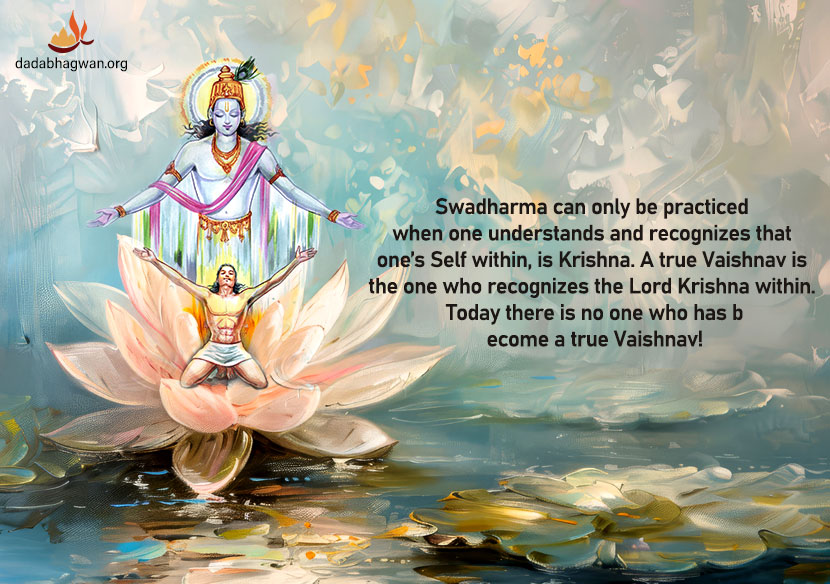
Explaining what Lord Krishna truly meant when He said, “Renounce all dharmas and come to My refuge,” Param Pujya Dada Bhagwan says, “Swadharma can only be practiced when one understands and recognizes that one’s Self within, is Krishna. A true Vaishnav is the one who recognizes the Lord Krishna within. Today there is no one who has become a true Vaishnav!” To conduct oneself in one’s Swadharma, it is essential to first know one’s own Self and to know the Self, it is necessary to go to the shelter of a Gnani Purush, someone who has realized the Self. In the Gita, Lord Shri Krishna says that the Gnani is the dearest of the dear to Him. There is no work on this earth more precious than the work done by a Gnani Purush who imparts this profound knowledge to people. Such a Gnani Purush is capable of burning away karmas in the fire of Knowledge and giving direct realization of the Self. Not even for a single moment does He forget the Self; there remains the awareness of “I am the Soul” day and night.
Only when an experienced Gnani Purush like Param Pujya Dadashri explains this profound truth in such simple language does the real distinction between Swadharma and pardharma become clear, and the true path to liberation shown by Lord Shri Krishna becomes attainable! In any other way, it is not possible.

subscribe your email for our latest news and events
Dada Bhagwan Foundation, Adalaj is a spiritual non-profit organization whose goal is to spread peace, harmony and everlasting bliss to the whole world through the spiritual science of Akram Vignan.
Ask a question and Get an assured response


