


How can one attain Anasakti Yoga?
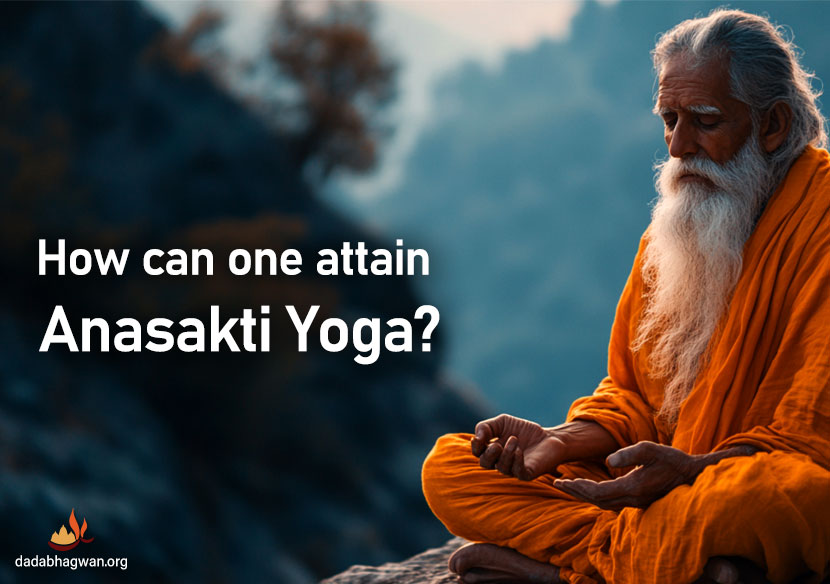
In the scriptures, various methods for becoming non-attached are described, which when we read, we try to become free from all attractions. But even if a person living in a household with family tries to become non-attached to the home, spouse, or children, they are still not able to achieve complete success. If one leaves the house and goes to an ashram, even there, their attachment to disciples and scriptures keeps increasing. In reality, as long as there is the bodily belief that “this body is me,” one cannot enter into the state of non-attachment (anasakti yoga or anasakta yog). On the contrary, attachment and aversion only increase. But when the Self is realized, one naturally and effortlessly becomes non-attached.
In the Bhagavad Gita, Lord Shri Krishna had transformed Arjun into an Atmayogi (Self-realized), by asking him to set aside manoyoga (union with the thoughts that arise in the mind) and dehayoga (physical yoga). But did Lord Shri Krishna make Arjun do anything in order to become non-attached? Did He ask Arjun to chant names, perform rituals, engage in devotion, meditation, or yogic practices? Did He tell Arjun to leave Draupadi, renounce his kingdom, or stop the war? No, the Lord only gave Arjun knowledge. He explained everything that devotion is supreme, renunciation is excellent and non-attachment is the highest, but He did not make Arjun perform any external practices.
There are two ways to reach a destination. One way is to keep looking at the map, trying to figure out the path by yourself, searching and searching until you eventually reach it. The other way is to find a skilled local guide or driver, sit in their vehicle, and simply go along with them. Even if you fall asleep on the way, you will still reach the destination smoothly. In the same way, receiving knowledge directly from a Pratyaksh Gnani (living Gnani) like Lord Krishna makes reaching the ultimate destination effortless, just as Arjun reached, easily and safely, through the grace of the enlightened One.
Truly speaking, the moment one knows the Self and becomes vitaraga meaning when attachment to the ego–intellect dissolves and attachment toward the Self begins, that is called becoming non-attached. To firmly hold the awareness “I am the Soul” is called the anasakti yoga. Anasakt (beyond all attraction) is the path that leads one toward the real Self. At present, one is still far from the Self, but the very effort of moving toward the Self is the beginning of the yoga of non-attachment. From that point until one fully becomes established as the Self, that entire effort is the anasakti yoga.
In the Bhagavad Gita, Shri Krishna tells Arjun, “Know Me in My tattva swaroop (in the form of an eternal element),” and then grants him the divine vision to behold that tattva swaroop. After receiving this vision, Arjun finally said,
nashto mohah smritirlabdha tvatprasadanmayaachyut |
sthitosmi gatasandehah karishye vachanam tava ||73 ||
Meaning, O achyuta (not subject to fall), by Your grace, my delusion has been destroyed, and as my doubts are gone, I have become steady in Knowledge. Now, I will act according to Your command.
How can this deluded vision break? Sanjay could describe the entire knowledge of the Bhagavad Gita to King Dhritarashtra by the divine ability he had to see things as they were. Yet, Sanjay did not attain that Knowledge that Arjun received directly from Lord Shri Krishna. So, thousands of years later, how can we attain that same Knowledge just by reading the Bhagavad Gita? For that, one must go to a living awakened One who has realized the Self and is capable of giving that realization to others.
Param Pujya Dada Bhagwan says that, “It is when one realizes, ‘I am beyond attraction and attachment’, that one becomes liberated. One does not need to remove the infatuation and attraction; one just needs to realize that he is beyond attachment.” He explains that just as tea tastes bland after eating a jalebi, in the same way, once one attains their true Self, the world feels bland; meaning attachment to the worldly life naturally falls away.
Just as the attraction between a magnet and a needle does not go away, similarly, no matter how hard we try while living in the world, attachment does not fully leave us. Its intensity may reduce, but complete detachment does not happen. This is because every part of worldly life is filled with attachment and possessiveness; attachment to one’s own name, attachment to family, attachment to husband–wife, attachment to children, attachment to the home, attachment to one’s work, attachment to money. When does attachment go away? It goes away only when the ‘Self’ becomes detached.
Param Pujya Dada Bhagwan explains the way to become detached, saying that detachment arises only after the ego dissolves. When both ego and possessiveness fall away, that is anasakt! Here, He shows the way to break our original mistake in order to attain detachment.
Dadashri: That is the root cause, and one will find a solution when it is destroyed.
You see things as good and bad because of your intellect. What is the function of the intellect? It always looks for profit and loss, advantages and disadvantages, wherever it goes. Besides this, it has no other function. Now, you have to get away from this intellect. You should remain as the Self, the unattached. You should become the Self, the One beyond all attachment and abhorrence. The real nature of the Self is that it is above all attachment and abhorrence. You too should become that. All that is needed is to change your nature, come home to your real nature away from your false nature.
How can one become a God when one still has infatuation and attraction? How can there be union between infatuation and attraction and love? How can one be a God when one has anger within?
Whatever element God is made of, you become that element. That, which is eternal, is liberation. That which remains always, that is liberation.
The easy way to become detached is to attain Self-realization. Just as when we start walking from Ahmedabad toward Vadodara, we don’t have to “leave” Ahmedabad, it naturally gets left behind. In the same way, when the awareness of “Who am I?” and “Who is the doer?” arises and one begins moving toward the Self, true detachment naturally happens.

subscribe your email for our latest news and events
Dada Bhagwan Foundation, Adalaj is a spiritual non-profit organization whose goal is to spread peace, harmony and everlasting bliss to the whole world through the spiritual science of Akram Vignan.
Ask a question and Get an assured response


