


Lord Krishna
"Lord Krishna is not an ordinary King. He was not the doer of anything. His vision showed that the war will not stop and He told Arjun that you will fight in the war. Lord Krishna was a Narayan Vasudev."


Lord Krishna, meaning the one who transformed from a mere human (Nara) to the divine (Narayana)! Krishna has truly become an exceptional individual. He was a Vasudev (the one who has evolved from being an ordinary human into becoming God), meaning one who enjoys all worldly things but is entitled to salvation. Despite having thousands of queens, He was a naishthik brahmachari (the One who has constant inner intent of devotion and sincerity towards celibacy of the mind, speech, and body). Lord Krishna is destined to be a Tirthankar (the absolutely enlightened Lord who can liberate others) in the future, through whom millions of people will attain Atma Gnan (knowledge of the Self) and progress on the path to moksha (the state of ultimate liberation).
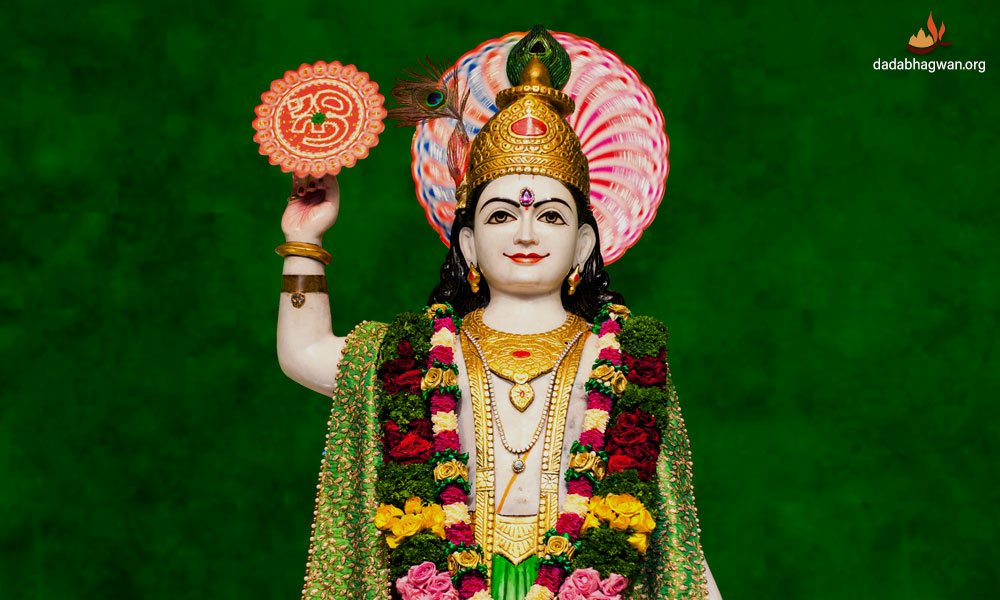
Thousands of years ago, Shri Krishna lived, and even today, people worship and adore Him with great devotion. People all over the world strive to understand and apply the wisdom of the Bhagavad Gita, which He imparted, in their lives!
Some people worship Lord Krishna as a playful child (Lallaji), like a little one swinging in a cradle, while others adore Him as the mischievous Nandlal performing Raas Leela with Radha and the Gopis. Some worship Him as the flute-playing Gopal, and others as Arjuna’s charioteer on the battlefield of Kurukshetra. Among these forms—Bal Krishna, Yogeshwar Krishna, Shrinathji, and Tirupati Balaji—which is His true form? Let us discover the true form of Lord Krishna.

"Lord Krishna is not an ordinary King. He was not the doer of anything. His vision showed that the war will not stop and He told Arjun that you will fight in the war. Lord Krishna was a Narayan Vasudev."
Om Namo Bhagavate Vasudevaya!
Lord Shri Krishna was a Vasudev. Vasudev means one of the sixty-three Shalaka Purush (human beings with extraordinary, super human energies and accomplishments)! In every era, there are these sixty-three excellent beings who are marked as worthy of the path to moksha.
Among the sixty-three Shalaka Purush, twenty-four are Tirthankar (the absolutely enlightened Lord who can liberate others), who have completely conquered anger, pride, deceit, and greed. Then, twelve Chakravarti kings are rulers of the entire earth and its six continents. Additionally, there are nine Vasudevs and, opposing them, nine Prativasudev (a rival of Vasudev). A battle naturally occurs between them, resulting in the death of Prativasudev at the hands of Vasudev, who then becomes the ruler of the entire world. Besides them, there are nine Baldevs (the step brother of a Vasudev Lord who is one of the 63 Shalaka Purush). Vasudev and Baldev are brothers and share a deep affection for each other. Lord Krishna is called Vasudev, and His brother Balarama is called Baldev. All these men are called God in embodied form, because the complete God is manifested within them.
The title of Vasudev is a supernatural status. Those born as Vasudev have a remarkable influence even before several incarnations. Their power is such that people get scared just by looking into their eyes. When they walk, the earth trembles. Their very presence causes people to scatter. They possess uniquely distinct characteristics.
Shri Krishna is often depicted performing Raas Leela with Radha and the Gopis. Some people criticise Him by calling His character immoral, but in reality, Shri Krishna was a naishthik brahmachari. One who is steadfastly committed to celibacy in intent is called a naishthik brahmachari! Krishna Bhagwan had thousands of queens, and although He was not celibate in action, in His intent, He was always devoted to celibacy; that is why He is called a naishthik brahmachari.
Just as a person may steal occasionally by chance but always holds the intent that “one should not steal,” such a person is considered a naishthik achaurya (inner intent of non-stealing). Similarly, if a person appears to give charity outwardly but inwardly thinks, “I want to take everything from these people,” then that is not considered charity. In the same way, what truly matters is the sincerity and dedication within, rather than the outward action seen by the senses. Once, the Gopis had to cross the Yamuna River to take food to Sage Durvasa on the other side, but the river was flooded and impossible to cross. They asked Lord Krishna what to do. He told them, “Go and tell the Yamuna River that if Shri Krishna is a lifelong celibate, then please give way!” The Gopis conveyed this, and the Yamuna River made a path for them. Similarly, on their return, Sage Durvasa said, “If Durvasa is lifelong faster, then the Yamuna River should give way!” and so it happened. Thus, although Sage Durvasa ate food, he was always a nirahaari (non-eater), and likewise, despite having thousands of queens, Lord Shri Krishna was a naishthik brahmachari.
In reality, a Gopi is not just any woman. During Shri Krishna’s time, people who took care of cows were called ‘Gop,’ which means a person who rears cows. From this, the name ‘Gopi’ originated. In the devotion of a Gnani Purush (One who has realized the Self and is able to do the same for others), even men were considered Gopis, and it is only through being a Gopi in devotion that one attains salvation. Similarly, the word ‘Radha’ comes from ‘Radh.’ The effort to become like the worshipped one is called ‘Radh,’ which means worship. Wherever there is worship of the Lord—that is, where there is ‘Radha’—there is also ‘Krishna’! The relationship between Lord Krishna and Radha symbolises the devotee’s worshipful devotion toward the Lord.
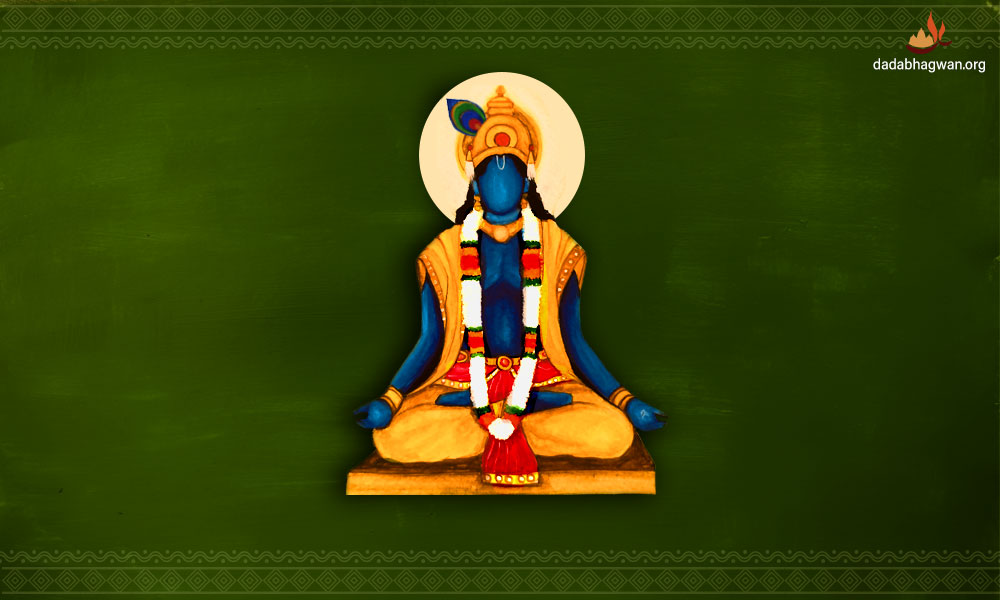
Lord Krishna Himself was a naishthik brahmachari. Not only that, He had great admiration and respect for all celibates and renunciants! He had told Lord Neminath, “Though I am not capable of accepting the path of renunciation myself, I am ready to support/adopt anyone in my kingdom who wishes to take initiation. I will take full responsibility for their livelihood, their families, and their protection”. Such was His tremendous encouragement. Because of Him, many people could accept initiation from Lord Neminath without any worry and achieve atma kalyan (Salvation of the Soul).
He had such great reverence for renunciants that He respectfully saluted countless saints with utmost devotion! Lord Krishna received the kshayak samkit (permanent conviction of the right belief) from Lord Neminath, and in that same birth, He also bound the Tirthankar gotra (the status as a Tirthankar)! This means that in the upcoming chovisi (the succession of twenty-four Tirthankar Lords in the third and fourth era of each half-cycle of time), Lord Shri Krishna will be a Tirthankar Lord!
Sudarshan means a wheel or discus, generally considered the spinning weapon on the right index finger of Lord Shri Krishna's hand. But what does this chakra truly symbolise?
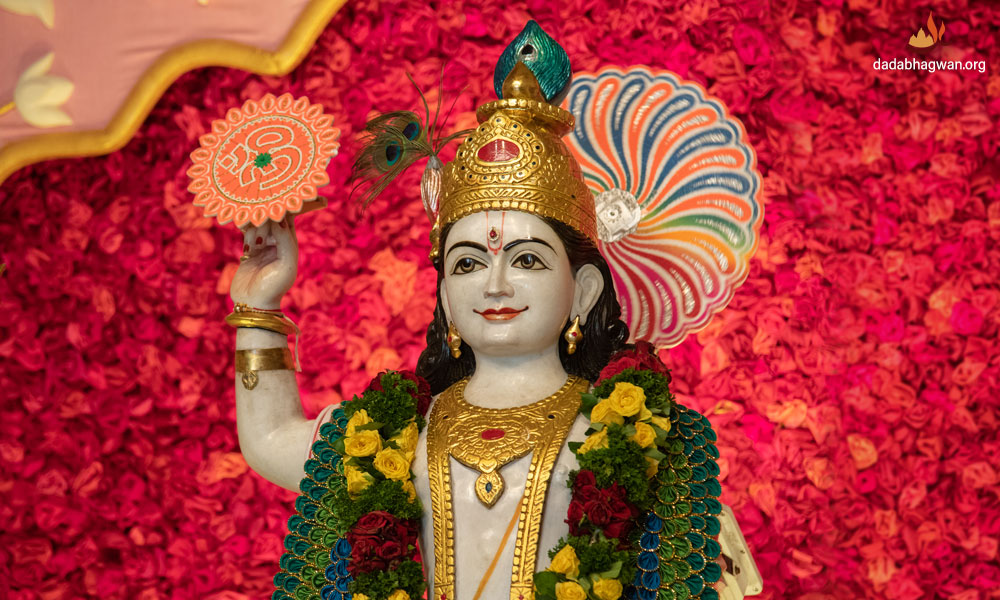
The Sudarshan Chakra was not a weapon. Sudarshan means Samyak Darshan (right belief that 'I am pure Soul'). Lord Neminath, the Tirthankar who was the cousin of Shri Krishna, was the one from whom He received this Samyak Darshan. Darshan means relative vision, and Sudarshan means Samyak Drashti (the right belief of ‘I am pure Soul). The realisation "I am the Soul" is a Samyak Drashti. Due to ignorance, beings in the world live under the illusion that they are the body with a name and form. When knowledge of the Self is attained, the veils of ignorance are pierced, and ‘Sudarshan’ (right belief of ‘I am pure Soul’), meaning Samyak Samjan/Samajh (right understanding), manifests. When all deluded beliefs are broken, the right belief that “I am the Soul” is established, and that is Samyak Darshan.
Because of this vision, Lord Krishna remained untouched by all worldly illusions, despite having a magnificent kingdom, thousands of queens, and immense wealth. Lord Shri Krishna imparted this same Samyak Darshan to Arjuna in the middle of the Kurukshetra battlefield.
Kaliya Daman
One of the most popular leelas of Lord Shri Krishna is the suppression of Kaliya Nag (the serpent Kaliya). It is said that when Shri Krishna was playing with His friends as a child, the ball fell into the Yamuna River. In that river lived the extremely poisonous serpent Kaliya. To retrieve the ball, the Lord dived into the river, subdued the serpent, and danced on its hood.
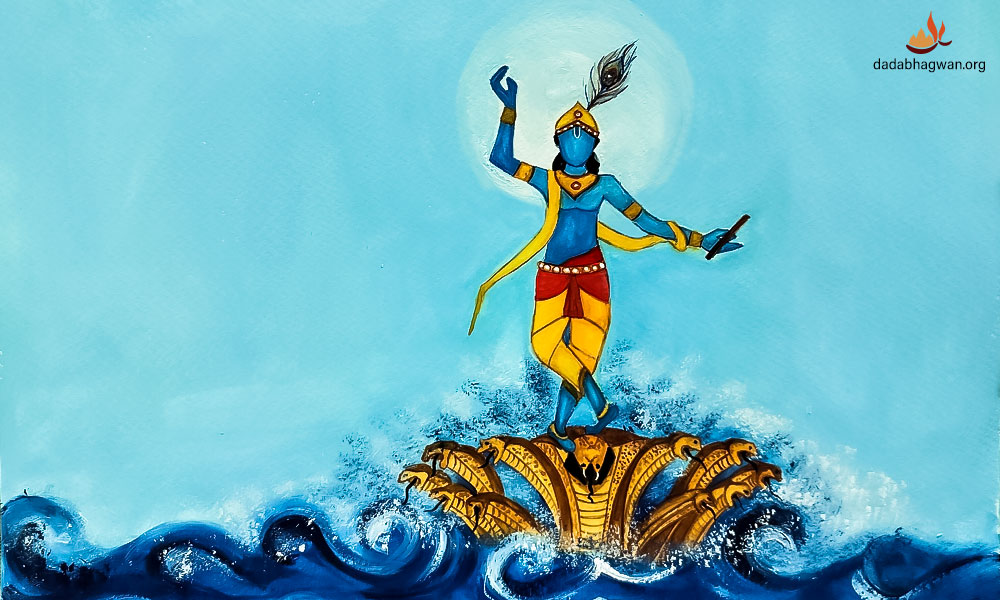
Param Pujya Dadashri explains the reality behind this story. In the Kaliya Daman, the serpent symbolises anger. Within all of us, there resides a serpent of anger that, by striking with its hood, spreads the poison of bitterness in relationships with others.
The Lord tamed the serpent of anger, which is why He was called Krishna. The one who tames his actions is Krishna! To help children understand this, the story of Kaliya Daman was told using this metaphor. However, over time, the original meaning was forgotten!
Govardhan on One Finger
One of the popular Krishna leelas is of Lord Krishna with Govardhan Parvat. It is said that He lifted the Govardhan Mountain on His little finger to protect the villagers and animals from heavy rainfall. In reality, Govardhan is not a mountain. Here, the true meaning of Govardhan is "go-vardhan," which means the nurturing or protection of cows.
During Lord Shri Krishna’s time, violence had greatly increased. In India, cows are considered sacred, but back then, violence against cows began, and their meat was being consumed. So, what did Lord Shri Krishna do? He initiated Govardhan and cow protection (Gau Raksha). Cow protection stopped the violence against cows, and with Govardhan, efforts to increase the cow population began. Lord Shri Krishna accomplished a very noble task through this.
With time, the phrase "lifting Govardhan Mountain on the finger" remained in the literal sense, but its subtle meaning was lost. A logical question arises, if Govardhan Mountain was lifted, why not the Himalayas? And if God was so powerful, then why did He die after being struck by an arrow in the leg?
In reality, the Lord pointed towards the purpose of Govardhan. Under His leadership, cow shelters were established in various places, where arrangements were made for thousands of cows to be nourished. With both Govardhan and cow protection (Gau Raksha) in place, the production of milk and ghee increased in many regions. The cowherds, who contributed to this purpose alongside Him, were called Gop and Gopi!
Thus, Govardhan symbolises the preaching of non-violence by Lord Krishna. From this episode of His life, we learn that there should not be any violent tendencies in a person’s life. If our entire life is spent in the service of non-violence, that is called a non-violent intent.
Lord Shri Krishna existed thousands of years ago. During His time, there was no religion called Vaishnavism. Lord Krishna had referred to Atma dharma (the religion of the Self) as one’s true religion. The Vaishnav sect was established only after the Lord departure. In contrast, Pushti Marg was founded by Shri Vallabhacharya just five hundred years ago.
Five hundred years ago, Muslim rulers were wreaking havoc in India. Women were afraid to step outside their homes or even go to temples, so no one dared to leave their homes. Hinduism was on the verge of extinction. At that time, Shri Vallabhacharya revitalised a form of religion suited to the times, which showed a way to practice devotion while staying at home. This path of devotion came to be known as Pushti Marg.
Herein, the devotees worship, serve, and show devotion to the child form of Lord Shri Krishna, known as Thakur Ji. Devotees bathe Thakur Ji, offer Him food, put Him to sleep, and attend to all His needs. Devout Vaishnavas carry Thakur Ji with them wherever they go and consume only sattvic (pure and vegetarian) food at home. The entire day, their chit (Subtle component of vision and knowledge in the inner functioning instrument called antahkaran) is absorbed in thoughts of the Lord, which is why this path of devotion is considered an elevated spiritual path. Now, in the presence of a Gnani Purush (One who has realized the Self and is able to do the same for others), the Atma dharma (the religion of the Self) has come to light!
In His previous incarnation, Lord Shri Krishna was a merchant. He faced severe disdain and disrespect from everywhere. Then He became a monk and undertook intense austerities and renunciations. To exhaust all the accumulated merits earned through harsh penance, He made a niyanu (Firm inner resolution) that the entire world should worship Him. Niyanu means spending the entire accumulation of merit to achieve one single goal. As a result of this resolution, in His incarnation as Krishna, He attained a place worthy of worship, and even today, He is deeply revered by people.
What is a true devotee of Lord Shri Krishna like? On one hand, we say, “The soul (jiva) should not engage in worrying or thinking unnecessarily; whatever Lord wills or causes to happen will happen.” But on the other hand, we remain drowned in worry and sorrow day and night. How can this be called true devotion to Lord Shri Krishna? Once we take refuge by saying “Shri Krishna: Sharanam Mama” (Lord Krishna is my refuge), then what is there to worry about? Param Pujya Dada Dadashri explains the way of true devotion to Krishna Bhagwan, saying, “Every morning, five times, you should fold your hands in front of a photo of Lord Krishna and say, ‘O Lord! You have said that I should not worry at all. Since everything is in Your hands, I still end up worrying. What can I do? My strong desire is not to worry at all. So please, O Lord, grant me such grace and strength that I do not worry again.’ If, despite this, you worry again, then once more make the same request to the Lord. Keep doing this, and then no worries will remain. This is how We have connected with Lord Krishna!”
Krishna Bhagwan had said, “Where the world is awake in the material realm, there Krishna sleeps; and where the world sleeps, there Krishna is awake.” This means that the world is awake in the realm of worldly existence, while Lord Krishna is awake in spirituality. Ultimately, one must attain awakened awareness in spirituality because worldly awareness is egotistical awareness, and moksha comes through egoless awakened awareness.
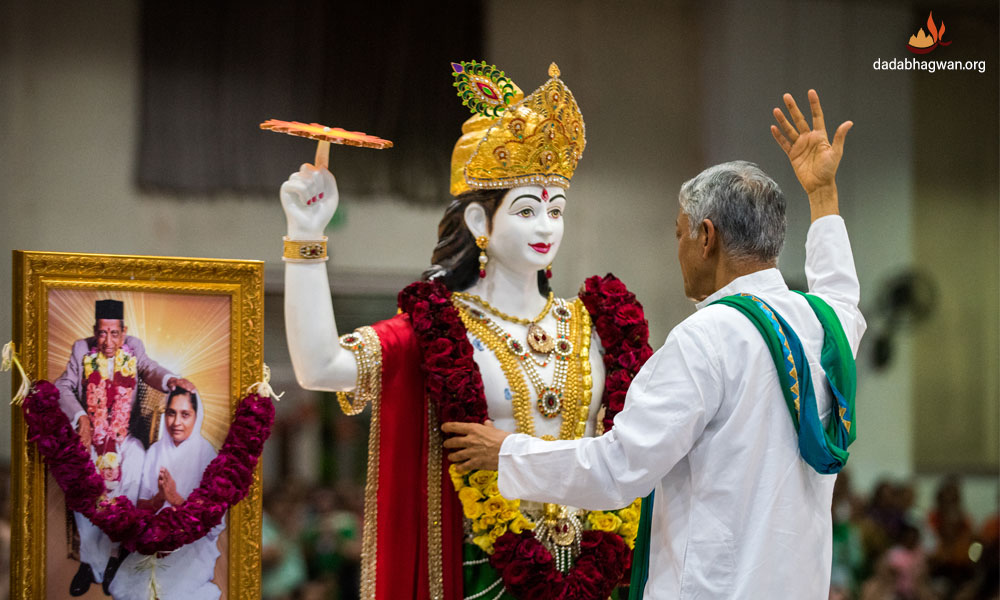
True devotion to Lord Shri Krishna arises when one recognises His true form; this is the highest form of devotion. In worship of the idol form, the devotee and the Lord remain separate. Only a Gnani Purush can help one experience the true Lord Shri Krishna. When we know our true Self, we experience the Soul within, and that is the true Krishna. When one dwells in their true nature, then “Atmavat Sarvabhuteshu” means one sees all beings as the Self. At that point, the devotee and the Lord become one.
On the battlefield of Kurukshetra, Arjuna was overwhelmed with despair at the thought of fighting against his relatives and elders. To dispel Arjuna’s delusion and prepare him for battle, Lord Krishna imparted the knowledge that came to be known as the Bhagavad Gita.
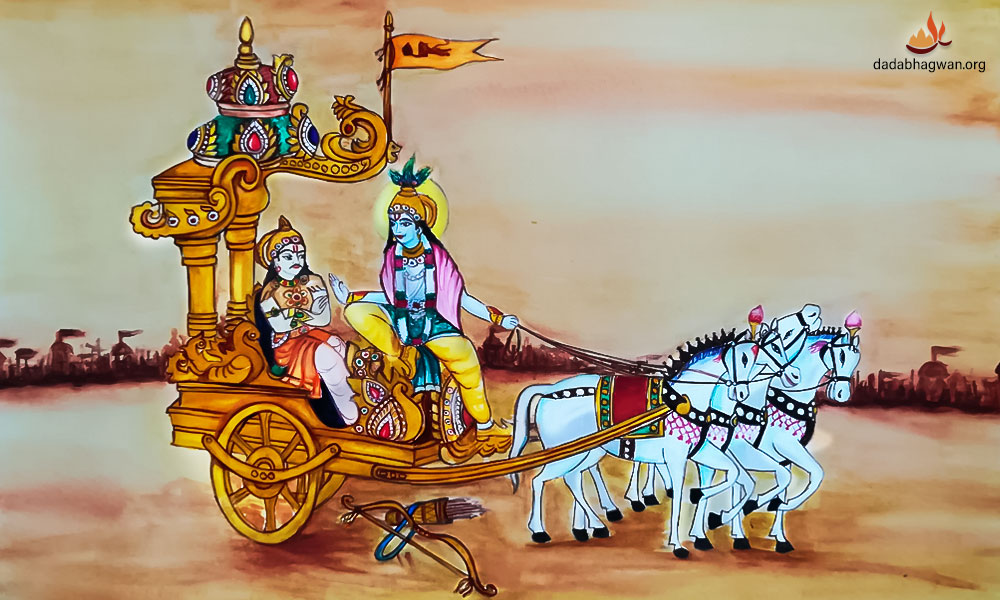
Before the great battle of the Mahabharata, Lord Shri Krishna said to Arjuna, “You have not recognised my true form. This body is not me; I am Atma swaroop (the Real form as the Self). Weapons cannot pierce me, fire cannot burn me, water cannot wet me; I am the pure Soul. O Arjuna! You are also that Soul. Those whom you are refusing to fight are all Souls as well. The Soul neither takes birth nor dies. At this moment, fighting is your duty as a warrior (Kshatriya), so fulfill it.”
With the knowledge of the Self received from Krishna Bhagwan, Arjuna’s despair was dispelled. Despite fighting the fierce war of the Mahabharata, none of Arjuna's actions bound him karma, and ultimately, he achieved salvation by seeking refuge in Lord Neminath.
The knowledge that Lord Krishna imparted to Arjuna is the same knowledge that a Gnani Purush provides to us through Akram Vignan (the spiritual Science of the step-less path to Self-realization). This knowledge gives us the vision that enables us to perform all worldly responsibilities without accumulating any karmic bondage.
A detailed understanding of the Bhagavad Gita is available on Shrimad Bhagwad Gita Ki Yatharth Samajh.

subscribe your email for our latest news and events


